Nepal’s Top 10 Export Items in Two Months: Soybean Oil Dominates Half of Total Exports
Author
NEPSE TRADING

Kathmandu – In the first two months of the current fiscal year 2082/83 (July–September 2025), Nepal exported goods worth Rs. 47.31 billion, marking an impressive 88.57% increase compared to the same period last year. However, the surge is largely concentrated in a few categories, with soybean oil alone accounting for more than half of total exports.
Soybean Oil: The Backbone of Exports
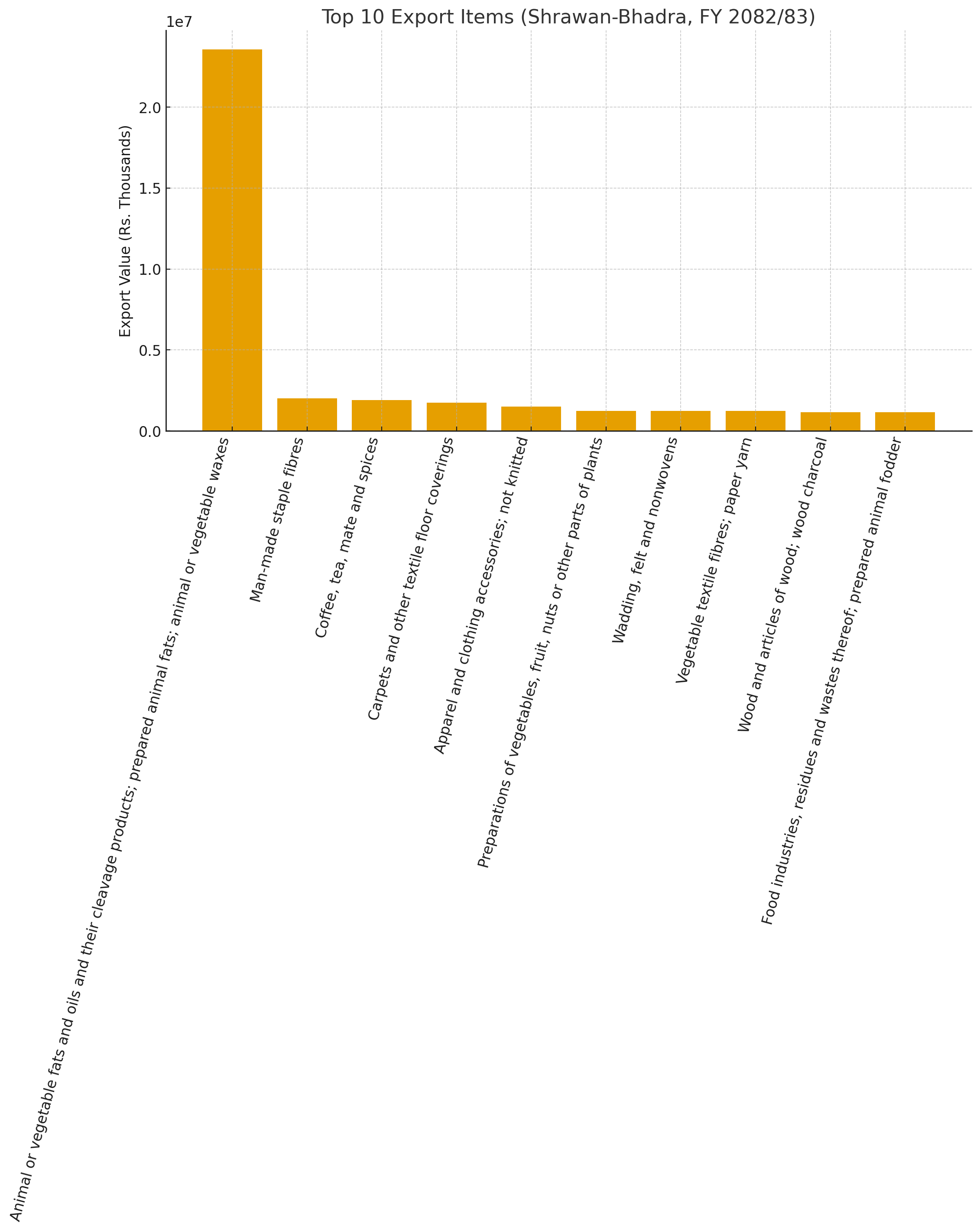
The single largest export is soybean oil, amounting to nearly Rs. 20.42 billion in just two months. This represents 56.84% of total exports. The figure highlights Nepal’s overwhelming dependence on one product, raising concerns about export diversification. Although processed soybean oil is shipped mainly to India and third countries, the raw crude oil is itself imported, making Nepal’s largest export paradoxically tied to imports.
Tea, Coffee, and Spices
The second-largest category is tea, coffee, and spices, with exports worth Rs. 18.94 billion. Products such as ginger, cardamom, pepper, and Ilam tea are gaining global recognition, helping strengthen Nepal’s export profile in agricultural commodities.
Garments, Textiles, and Fibers
The next major group of exports relates to textiles and garments:
Man-made staple fibers (Rs. 20.12 billion)
Non-knitted apparel (Rs. 14.95 billion)
Knitted apparel (Rs. 9.18 billion)
Vegetable textile fibers and yarn (Rs. 12.33 billion)
This reflects the continuing strength of Nepal’s garment and textile sector, long a backbone of export earnings.
Carpets and Wool Products
Traditional items like handmade carpets (Rs. 17.33 billion) and wool/woolen yarn products also remain important. These are primarily exported to European markets, showcasing Nepal’s cultural and artisanal export heritage.
Other Export Items
The top 10 exports also include processed agricultural products (vegetables, food preparations, animal feed) and wood products. Growth in these categories suggests that some domestic industries are expanding their export footprint.
While the growth rate of exports appears encouraging, the structure remains heavily imbalanced. With over half of the earnings concentrated in soybean oil and large shares in garments and carpets, Nepal’s export basket is highly vulnerable. Any decline in global demand or trade restrictions on soybean oil could sharply reduce Nepal’s foreign exchange earnings.
Experts warn that this over-dependence makes Nepal’s economy fragile. Without diversification into other sectors such as IT services, high-value agriculture, processed food, and manufacturing, the sustainability of this growth remains questionable.
Nepal’s export growth in the first two months of FY 2082/83 is promising, but the underlying reality is that the country is still dependent on a narrow range of products. For long-term resilience, Nepal must focus on diversifying exports, enhancing domestic value chains, and exploring new markets beyond its traditional partners.