
Top
Ceasefire Announcement Sends Asian Markets Surging, Oil Prices Crash in Historic Single-Day Drop
Ceasefire Announcement Sends Asian Markets Surging, Oil Prices Crash in Historic Single-Day Drop A fragile but consequential peace signal emerged from one of the world's most volatile geopolitical flashpoints on Wednesday, as Iran, the United States, and Israel announced a two-week ceasefire agreement that sent immediate and powerful shockwaves through global financial markets. Asian stock exchanges, which had been operating under the shadow of escalating Middle Eastern tensions for months, responded with some of their sharpest single-session gains in recent memory. Oil prices, meanwhile, recorded one of their most dramatic single-day collapses in years. The world, it seems, had been holding its breath — and Wednesday morning, it finally exhaled.
Dipesh Ghimire
6 min read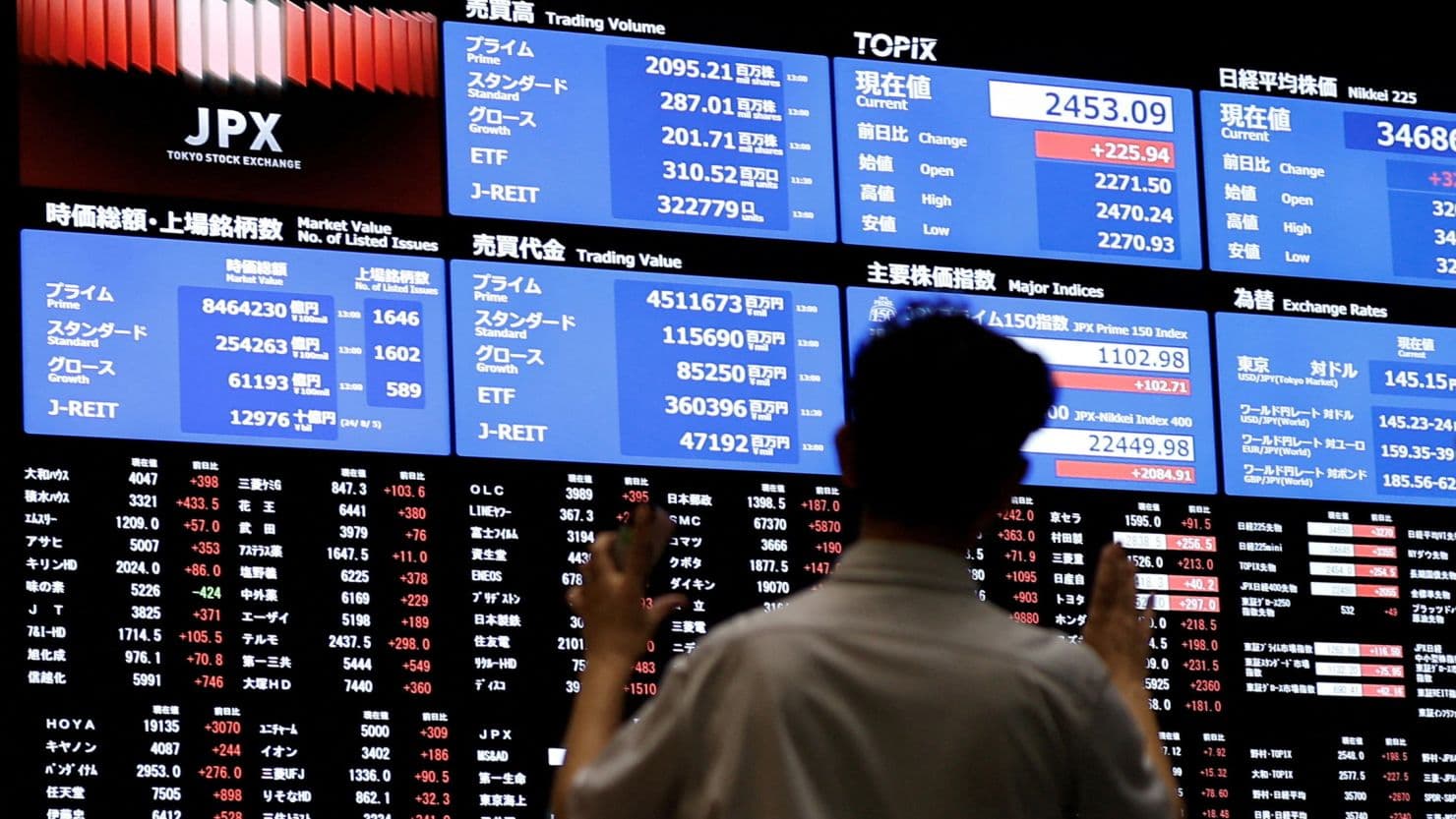
A fragile but consequential peace signal emerged from one of the world's most volatile geopolitical flashpoints on Wednesday, as Iran, the United States, and Israel announced a two-week ceasefire agreement that sent immediate and powerful shockwaves through global financial markets. Asian stock exchanges, which had been operating under the shadow of escalating Middle Eastern tensions for months, responded with some of their sharpest single-session gains in recent memory. Oil prices, meanwhile, recorded one of their most dramatic single-day collapses in years. The world, it seems, had been holding its breath — and Wednesday morning, it finally exhaled.
The rally across Asian equity markets was both swift and broad-based, leaving little doubt about how deeply geopolitical anxiety had been suppressing investor sentiment in recent weeks. Japan's Nikkei 225 surged 5.28 percent, adding 2,822.44 points in a single session — a move of that magnitude in one of the world's most closely watched indices is not a routine market fluctuation but a statement of collective relief. South Korea's KOSPI climbed 5.61 percent, gaining 308.11 points, while India's GIFT Nifty rose more than 3 percent to touch the 23,841 level. Hong Kong's Hang Seng advanced 3.04 percent and Taiwan's Weighted Index gained 3.72 percent. Across the region, the pattern was unmistakable — investors who had been sitting on the sidelines, waiting for clarity, rushed back into the market the moment the ceasefire news broke.
Nowhere was the market reaction more dramatic than in the energy sector. The Strait of Hormuz — the narrow waterway through which more than a third of the world's seaborne oil passes — had been at the center of the crisis, with fears of a full blockade pushing energy prices to dangerous highs in recent weeks. The moment Iran committed to allowing safe passage through the strait and halting its military operations, the logic that had been keeping oil prices elevated evaporated almost instantly. Brent crude, the international benchmark, collapsed 13.04 percent to $95.02 per barrel. West Texas Intermediate, the American benchmark, fell even harder — dropping 13.76 percent to $97.41 per barrel. A double-digit percentage decline in crude oil prices within a single trading session is an extraordinarily rare event. It speaks to just how much of a war premium had been baked into energy markets over recent weeks, and how quickly that premium can disappear when the threat recedes.
The behavior of gold on Wednesday told a subtler and perhaps more honest story about the true state of investor confidence. In theory, a ceasefire that reduces geopolitical risk should weaken demand for safe-haven assets like gold, as investors rotate back into equities and riskier instruments. And yet gold rose 2.13 percent — gaining $100.45 — even as stocks surged. This apparent contradiction is not irrational. It reflects a market that is relieved but not reassured, encouraged but not convinced. A two-week ceasefire is not a peace treaty. Seasoned investors know that the underlying tensions that caused this conflict have not been resolved, and that the next two weeks of diplomacy will determine whether this pause becomes something more durable or simply a brief interruption before hostilities resume.
The diplomatic architecture behind this ceasefire is as significant as the ceasefire itself. Iranian Foreign Minister Sayed Abbas Araghchi took to the social media platform X to deliver his country's official position in unusually direct terms. Speaking on behalf of Iran's Supreme National Security Council, he stated that if attacks against Iran ceased, Iranian armed forces would likewise halt their defensive operations, and that safe navigation through the Strait of Hormuz would be guaranteed for a two-week period. The public, institutional nature of this declaration — made through the Supreme National Security Council rather than through informal channels — gave the announcement a degree of formal credibility that markets clearly took seriously.
What makes this diplomatic development particularly noteworthy is the role played by Pakistan as a mediator. Araghchi explicitly and publicly thanked Pakistani Prime Minister Shehbaz Sharif and Field Marshal Asim Munir for their mediation efforts — a rare and significant acknowledgment that places Islamabad at the center of one of the most consequential diplomatic developments in the Middle East in recent years. Pakistan has historically maintained working relationships with both the United States and Iran, a geographic and diplomatic positioning that made it a credible bridge between parties that have no direct diplomatic channel. The possibility of a formal peace summit in Islamabad is now being discussed, which would elevate Pakistan's international standing considerably if it materializes.
On the American side, President Donald Trump framed the ceasefire as a strategic success rather than a retreat. He announced the suspension of American bombing and military operations against Iran, citing Iran's ten-point proposal as a basis for negotiation and declaring that the United States had achieved the majority of its military objectives. Whether that framing reflects genuine military accomplishment or is a face-saving narrative designed for domestic political consumption is a matter of debate among foreign policy analysts. What is not debatable is the outcome — a cessation of active hostilities that the world's financial markets immediately priced in as unambiguously positive.
The broader geopolitical significance of this ceasefire extends well beyond the immediate market reaction. The Strait of Hormuz is not merely a shipping lane — it is the jugular vein of the global energy system. Any prolonged blockade or sustained military conflict in that corridor has the potential to trigger inflationary shockwaves that would ripple through every economy on earth, hitting import-dependent developing nations hardest. Nepal, which imports virtually all of its petroleum products and whose economy is acutely sensitive to global commodity prices, had significant exposure to that risk. A sustained decline in international oil prices, if it holds, could meaningfully reduce Nepal's import bill and create space for a reduction in domestic fuel prices — a development that would have broad implications for inflation, transportation costs, and the general cost of living.
For Nepal's stock market specifically, the external environment shift could not have come at a more critical moment. The NEPSE index has been trading in a technically fragile zone, having closed at 2,757.40 on Tuesday after failing to sustain a push above the key resistance level of 2,788. The psychological boost that comes from watching Asian peers surge 3 to 6 percent in a single session has the potential to translate into increased buying interest when NEPSE opens on Wednesday — though whether that sentiment translates into sustained volume and genuine structural recovery remains to be seen.
However, experienced market watchers would caution against reading too much permanence into Wednesday's euphoria. Two weeks is a very short window. The fundamental disagreements that produced this conflict — Iran's nuclear program, Israel's security requirements, America's strategic interests in the region, and the broader balance of power in the Middle East — are not problems that resolve themselves in a fortnight of diplomacy. The ceasefire has created an opportunity, not a solution. If the Islamabad summit fails to produce a framework for more lasting de-escalation, or if either side perceives the other as violating the terms of the agreement, markets could reverse course just as sharply as they rallied.
What Wednesday has demonstrated, above all else, is how deeply interconnected global geopolitics and financial markets have become. A ceasefire announcement made thousands of miles away in the Middle East moved stock indices across Asia within hours, crashed oil prices in a single session, and shifted the investment calculus for millions of people who have never set foot in Iran, Israel, or the United States. In that sense, Wednesday's market reaction is not just a financial story — it is a reminder that in the modern world, no economy, and no investor, is truly insulated from what happens at the world's pressure points.
Written by
Dipesh Ghimire
Related News



EVs Luxury Models Taxed Up to
5 min read
From Power to Price: New EV Tax Closes One Loophole but Opens Several Others
Up to Rs 20 lakh: 20% customs + 2.5% infrastructure fee Rs 20-30 lakh: 20% customs + 20% infrastructure fee Rs 30-40 lakh: 20% customs + 35% infrastructure fee Rs 40-50 lakh: 20% customs + 90% infrastructure fee Above Rs 50 lakh: 20% customs + 130% infrastructure fee
Dipesh Ghimire
·2 Jun, 2026


West Seti 400 kV
4 min read
Private Capital Enters Nepal's Power Grid: West Seti 400 kV Line Marks a Structural Shift
Taken together, the project is being viewed as an important milestone in the development of Nepal's transmission infrastructure — both for the precedent it sets in private participation and for the role it could play in turning the far-west into a genuine power-generating region rather than one whose rivers run untapped.
Dipesh Ghimire
·2 Jun, 2026
Budget 2084/84
2 min read
Budget Targets 7% Economic Growth, Vows Structural Reform of the Economy
Finally, the Finance Minister made a heartfelt appeal to all political parties, the private sector, workers, farmers, youths, entrepreneurs, migrant Nepalis, and all citizens to support the nation-building journey that the budget is set to lead, with a shared spirit of civil dialogue, collaboration, meaningful participation, and national unity.
Dipesh Ghimire
·31 May, 2026
Budget 2084/84
<1 min read
Finance Minister Presents Expenditure Estimates for Three Fiscal Years
The Finance Minister said the details regarding the technical assistance to be received from donor nations and agencies, and the assistance to be mobilised from international non-governmental organisations, have also been presented.
Dipesh Ghimire
·31 May, 2026
