
Top
Citizen Investment Trust Strengthens Financial Position with Steady Profit Growth
Citizen Investment Trust Strengthens Financial Position with Steady Profit Growth The Citizen Investment Trust (CIT) has reported a notable improvement in its financial performance in the second quarter of the current fiscal year 2082/83. The Trust recorded a net profit of NPR 665.3 million, reflecting a 6.92 percent increase compared to the same period last year. This growth indicates steady operational progress despite changing market conditions. In the corresponding period of the previous fiscal year, CIT had earned NPR 622.2 million in net profit. The latest figures suggest that the institution has been able to enhance its income-generating capacity while maintaining financial discipline. Analysts view this as a positive sign of institutional stability and long-term sustainability. During the review period, the Trust’s total income reached NPR 1.06 billion, up by 2.86 percent from NPR 1.03 billion recorded a year earlier. Although the growth rate in total income appears moderate, it reflects consistent expansion in core business activities. The gradual rise in income also highlights CIT’s ability to adapt to evolving financial environments.
Dipesh Ghimire
3 min read
The Citizen Investment Trust (CIT) has reported a notable improvement in its financial performance in the second quarter of the current fiscal year 2082/83. The Trust recorded a net profit of NPR 665.3 million, reflecting a 6.92 percent increase compared to the same period last year. This growth indicates steady operational progress despite changing market conditions.
In the corresponding period of the previous fiscal year, CIT had earned NPR 622.2 million in net profit. The latest figures suggest that the institution has been able to enhance its income-generating capacity while maintaining financial discipline. Analysts view this as a positive sign of institutional stability and long-term sustainability.
During the review period, the Trust’s total income reached NPR 1.06 billion, up by 2.86 percent from NPR 1.03 billion recorded a year earlier. Although the growth rate in total income appears moderate, it reflects consistent expansion in core business activities. The gradual rise in income also highlights CIT’s ability to adapt to evolving financial environments.
A major contributor to the profit growth has been the increase in service fees and commission income. This segment rose from NPR 810.1 million to NPR 839.4 million, showing improved performance in fund management and related services. The rising contribution from non-interest income suggests that the Trust is successfully diversifying its revenue sources.
However, not all income segments performed equally well. Net interest income declined from NPR 193.3 million to NPR 173.6 million during the same period. This drop indicates reduced earnings from interest-based investments, possibly due to lower interest rates or shifts in investment allocation. Experts believe that this trend reflects broader changes in the financial sector.
On the expenditure side, CIT has shown effective cost management. Total expenses decreased from NPR 208.6 million in the second quarter of the previous fiscal year to NPR 181.8 million in the current period. The reduction in operating costs has played a crucial role in supporting overall profitability and improving financial efficiency.
The Trust’s investment portfolio has continued to expand significantly. By the end of the review period, total investments stood at NPR 298 billion. Of this, NPR 145 billion has been placed in fixed deposits, while NPR 26.31 billion has been invested in term loans. In addition, NPR 31.68 billion has been allocated to shares of organized institutions, reflecting a balanced approach between safety and growth.
CIT has also invested NPR 1.31 billion in government bonds and NPR 2.72 billion in subsidiary companies. This diversified portfolio indicates a strategy focused on risk management and long-term returns. Financial experts note that such diversification helps the Trust remain resilient during periods of economic uncertainty.
In terms of capital strength, the Trust remains well-positioned. Its paid-up capital currently stands at NPR 6.80 billion, while the reserve fund has reached NPR 12.28 billion. These figures demonstrate a strong financial base, enabling the institution to absorb potential risks and support future expansion.
Key performance indicators also reflect stable growth. The Trust reported an earnings per share (EPS) of NPR 19.55 and a net worth per share of NPR 142.40. Similarly, the return on investment stood at 4.49 percent, suggesting efficient utilization of funds.
Overall, the second-quarter results indicate that Citizen Investment Trust is moving forward with steady financial progress. Growth in service-based income, effective cost control, and a diversified investment strategy have collectively strengthened its position. Market observers believe that if the Trust continues this balanced approach, it is likely to maintain sustainable growth in the coming years.
With improving fundamentals and disciplined management, CIT is gradually reinforcing its role as one of Nepal’s leading institutional investors. The latest performance reflects not only short-term gains but also a long-term commitment to financial stability and responsible investment practices.
Written by
Dipesh Ghimire
Related News



EVs Luxury Models Taxed Up to
5 min read
From Power to Price: New EV Tax Closes One Loophole but Opens Several Others
Up to Rs 20 lakh: 20% customs + 2.5% infrastructure fee Rs 20-30 lakh: 20% customs + 20% infrastructure fee Rs 30-40 lakh: 20% customs + 35% infrastructure fee Rs 40-50 lakh: 20% customs + 90% infrastructure fee Above Rs 50 lakh: 20% customs + 130% infrastructure fee
Dipesh Ghimire
·2 Jun, 2026

West Seti 400 kV
4 min read
Private Capital Enters Nepal's Power Grid: West Seti 400 kV Line Marks a Structural Shift
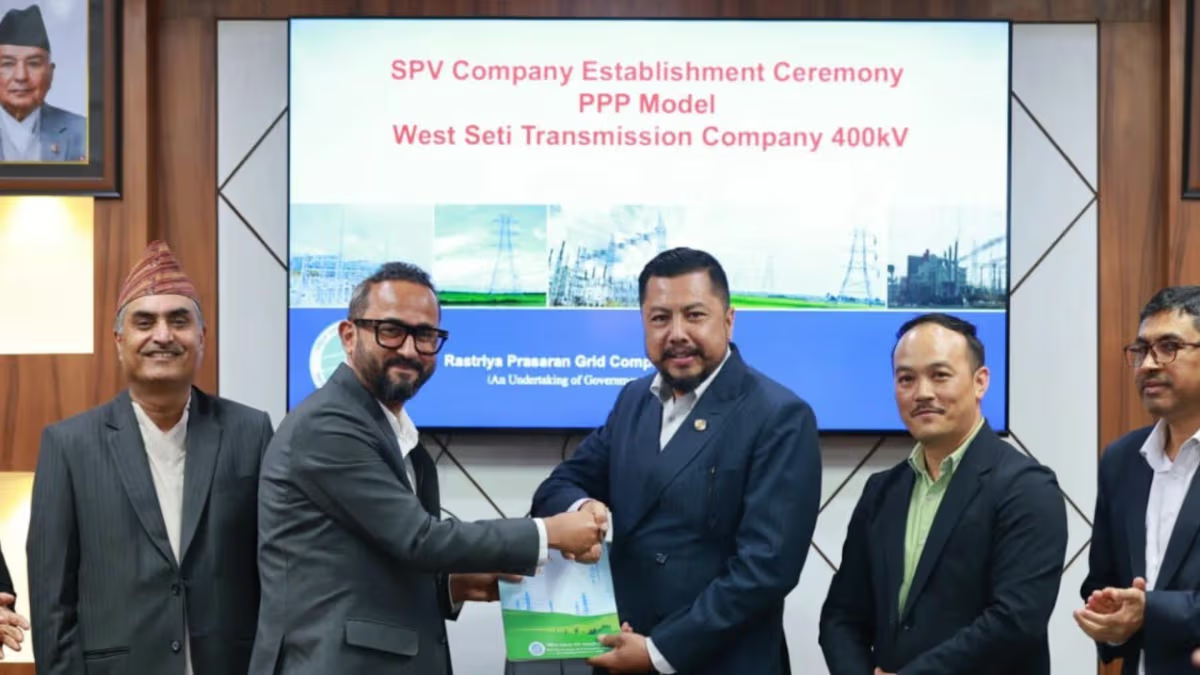
Taken together, the project is being viewed as an important milestone in the development of Nepal's transmission infrastructure — both for the precedent it sets in private participation and for the role it could play in turning the far-west into a genuine power-generating region rather than one whose rivers run untapped.
Dipesh Ghimire
·2 Jun, 2026

Budget 2084/84
2 min read
Budget Targets 7% Economic Growth, Vows Structural Reform of the Economy
Finally, the Finance Minister made a heartfelt appeal to all political parties, the private sector, workers, farmers, youths, entrepreneurs, migrant Nepalis, and all citizens to support the nation-building journey that the budget is set to lead, with a shared spirit of civil dialogue, collaboration, meaningful participation, and national unity.
Dipesh Ghimire
·31 May, 2026

Budget 2084/84
<1 min read
Finance Minister Presents Expenditure Estimates for Three Fiscal Years
The Finance Minister said the details regarding the technical assistance to be received from donor nations and agencies, and the assistance to be mobilised from international non-governmental organisations, have also been presented.
Dipesh Ghimire
·31 May, 2026
