Nepal's EV Tax
Excise Out, New Fee In: Nepal's EV Tax Overhaul Hits the Middle-Class Buyer Hardest
NADA's Upreti argues the market can absorb the higher taxes — on one condition. "Consumer purchasing power has to grow. Capital spending must rise to get money circulating in the market," he says. "If the domestic market gets moving, it energizes the entire sector." In other words, whether this tax overhaul dents Nepal's EV boom or merely skims revenue off it will depend less on the rates themselves than on whether the government spends its budget fast enough to keep buyers walking into showrooms.
Dipesh Ghimire
4 min read
Nepal has rewired the way it taxes electric vehicles. Through the Finance Bill for fiscal year 2083/84, the government has scrapped excise duty on EVs altogether, introduced a brand-new "Clean Infrastructure Investment Fee" in its place, and — most consequentially — changed the very basis on which the tax is calculated. The net result: most electric vehicles will get more expensive, and the segment squeezed hardest is precisely the one the budget claims to champion — the middle-class car buyer.
The bill, presented in parliament on Jestha 15 by Finance Minister Dr. Swarnim Wagle, dismantles a regime under which EVs — private, commercial and freight — attracted excise duty of 2.5 to 50 percent, with vehicles in the 50-to-300-kilowatt range paying 5 to 50 percent depending on motor capacity. That entire excise layer is now gone. But the new fee layered on top means the overall tax burden on EVs has risen rather than fallen.
The deeper structural change is the shift in the tax base itself. For years, Nepal taxed EVs by motor capacity in kilowatts; from this year, customs valuation — essentially the vehicle's price — becomes the principal basis. Surendra Kumar Upreti, president of the NADA Automobiles Association of Nepal, says the change will reshuffle rates and push prices up somewhat. The logic of the switch is defensible: under the kilowatt regime, an affordable car with a powerful motor was taxed heavily while an expensive car with a modest motor got off lightly, and manufacturers could game the system by tuning motor specifications. Price-based taxation is harder to dodge and more progressive on paper — but it lands squarely on what buyers actually pay at the showroom.
The new arithmetic for private cars makes the impact plain. Small EVs with a customs value of up to Rs 2 million, previously taxed at an effective 43 percent, now carry 45.5 percent with the 2.5 percent fee added. The Rs 2-to-3 million band — the best-selling middle-class segment in the Nepali market — jumps from 64 to 71 percent. Cars valued at Rs 3 to 4 million move from 85 to 92 percent, the Rs 4-to-5 million band leaps from 156 to 171 percent, and luxury EVs above Rs 5 million climb from 220 to 227 percent.
Note what those numbers reveal: a fee nominally set at 2.5 percent produces effective increases of 7 to 15 percentage points in most bands. That is the cascade effect of Nepal's pyramid-style vehicle taxation, in which each levy is computed on top of the previous one, so a small charge at the base multiplies by the time it reaches the sticker price. Politically, the 7-point jump in the Rs 2-3 million band is the most awkward: a budget marketed as middle-class-friendly has made the middle class's favorite vehicles — electric cars, jeeps and vans — measurably dearer.
Public transport, the most climate-efficient form of mobility, has not been spared either — arguably the oddest note in a reform branded "clean." Large electric buses seating more than 25 passengers previously paid 1 percent customs duty and 16.98 percent total effective tax; the customs rate has now been zeroed, yet the new fee lifts the total to 18.72 percent. Mini and microbuses fare worse: where 11-to-14-seat electric microbuses paid 27.41 percent under the old capacity-based rules, all vehicles from 11 to 25 seats have now been lumped into a single band taxed at 30.59 percent. For transport operators weighing a switch to electric fleets, the entry cost has just gone up.
Commercial and freight EVs, by contrast, get genuine relief. Milk tankers see their total tax cut from 23 to 19 percent, while refrigerated vans tick up modestly from 17 to 19 percent. Single and double cab pickups, loaders, trucks, tippers, dumpers and delivery vans used in industry and construction keep their old rates untouched — trucks, tippers and delivery vans stay at 40 percent. The policy intent is legible: protect the electrification of logistics even while taxing electric passenger mobility harder.
The comparison with fossil-fuel vehicles is where the reform's green tilt survives. Diesel and petrol commercial vehicles have been taxed more, not less: 11-to-25-seat fuel vehicles, previously charged between 116 and 148 percent, now sit at 132 percent, and fuel-powered double cab pickups rise from 178 to 183 percent. Set side by side, the gap remains enormous — 30.59 percent for an electric microbus against 132 percent for its diesel counterpart, and 40 percent for an electric pickup against 183 percent for a fuel-run double cab. EVs have become costlier in absolute terms, but the relative case for going electric is intact. Read that way, the reform looks less like a retreat from electrification and more like a revenue exercise that carefully preserves the incentive structure.
The restructuring will nonetheless send prices swinging widely across brands and models in the Nepali EV market. Cheaper models that happen to carry large motors — punished under the kilowatt regime — emerge as direct winners, while expensive, feature-heavy vehicles face steep new rates. One open question hangs over the whole exercise: the fee's name promises investment in clean infrastructure, but what it will actually finance remains to be seen.
NADA's Upreti argues the market can absorb the higher taxes — on one condition. "Consumer purchasing power has to grow. Capital spending must rise to get money circulating in the market," he says. "If the domestic market gets moving, it energizes the entire sector." In other words, whether this tax overhaul dents Nepal's EV boom or merely skims revenue off it will depend less on the rates themselves than on whether the government spends its budget fast enough to keep buyers walking into showrooms.
Written by
Dipesh Ghimire
Related News


EVs Luxury Models Taxed Up to
5 min read
From Power to Price: New EV Tax Closes One Loophole but Opens Several Others
Up to Rs 20 lakh: 20% customs + 2.5% infrastructure fee Rs 20-30 lakh: 20% customs + 20% infrastructure fee Rs 30-40 lakh: 20% customs + 35% infrastructure fee Rs 40-50 lakh: 20% customs + 90% infrastructure fee Above Rs 50 lakh: 20% customs + 130% infrastructure fee
Dipesh Ghimire
·2 Jun, 2026

West Seti 400 kV
4 min read
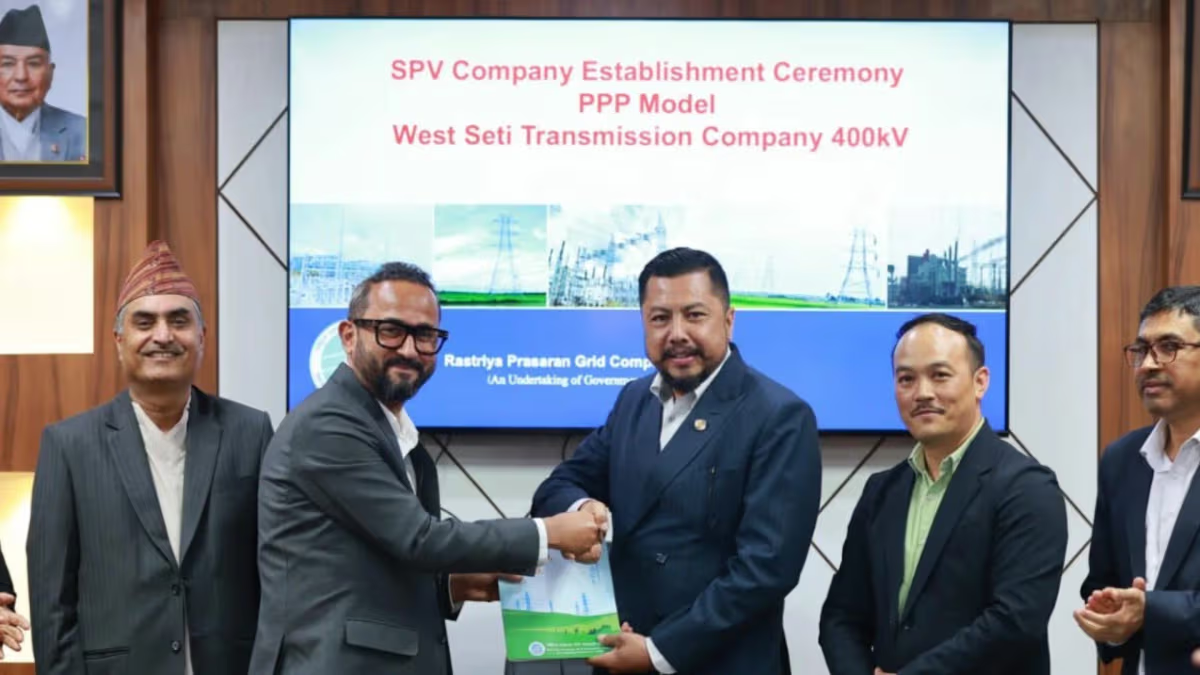
Private Capital Enters Nepal's Power Grid: West Seti 400 kV Line Marks a Structural Shift
Taken together, the project is being viewed as an important milestone in the development of Nepal's transmission infrastructure — both for the precedent it sets in private participation and for the role it could play in turning the far-west into a genuine power-generating region rather than one whose rivers run untapped.
Dipesh Ghimire
·2 Jun, 2026
Budget 2084/84
2 min read
Budget Targets 7% Economic Growth, Vows Structural Reform of the Economy
Finally, the Finance Minister made a heartfelt appeal to all political parties, the private sector, workers, farmers, youths, entrepreneurs, migrant Nepalis, and all citizens to support the nation-building journey that the budget is set to lead, with a shared spirit of civil dialogue, collaboration, meaningful participation, and national unity.
Dipesh Ghimire
·31 May, 2026
Budget 2084/84
<1 min read
Finance Minister Presents Expenditure Estimates for Three Fiscal Years
The Finance Minister said the details regarding the technical assistance to be received from donor nations and agencies, and the assistance to be mobilised from international non-governmental organisations, have also been presented.
Dipesh Ghimire
·31 May, 2026
