Exports Surge Sharply in First Four Months, but Trade Deficit Continues to Widen
Author
NEPSE TRADING
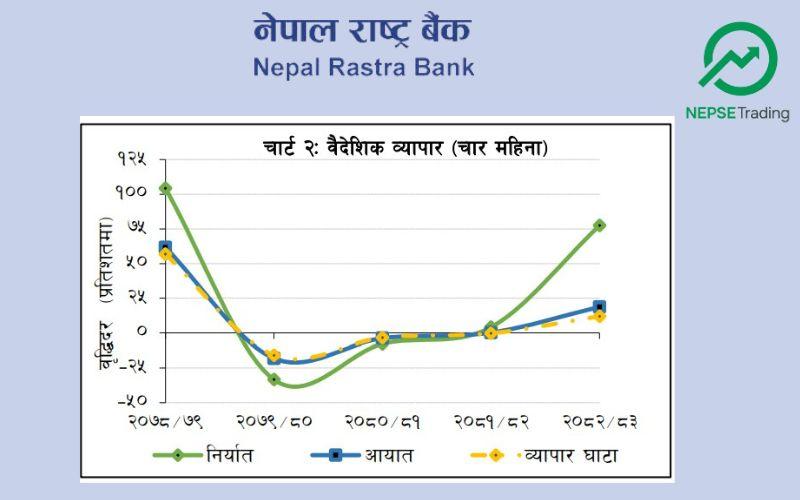
Nepal’s foreign trade showed a mixed trend in the first four months of fiscal year 2082/83 (up to mid-November 2025), with a strong rebound in exports offset by a faster rise in imports, keeping the trade deficit on an upward path. Data released by Nepal Rastra Bank indicate that while export growth has reached a multi-year high, the overall external sector remains under pressure due to Nepal’s heavy import dependence.
During the review period, total merchandise exports increased by 77.5 percent to Rs 93.50 billion, compared to a modest 4.2 percent growth in the same period last year. The sharp rise in exports is seen as a positive signal for the external sector, reflecting improved supply conditions and higher outbound shipments of selected commodities.
India Drives Export Growth, China Records Sharp Decline
By destination, exports to India surged by 113.9 percent, while shipments to other countries increased by 2.9 percent. In contrast, exports to China fell sharply by 56.2 percent, highlighting persistent challenges in accessing and sustaining the Chinese market.
In terms of commodities, exports of soybean oil, cardamom, palm oil, jute products, footwear and slippers increased during the period. However, exports of zinc sheets, particle board, tea, woollen carpets and handicrafts declined, indicating that export growth remains concentrated in a limited range of goods rather than being broad-based.
Imports Rise at a Faster Pace
Despite the export surge, imports expanded even more rapidly. Total merchandise imports increased by 18.7 percent to Rs 609.45 billion, compared to a marginal 0.2 percent increase in the same period last year. The rise in imports reflects a recovery in domestic demand as well as increased spending on raw materials and capital-intensive goods.
Country-wise, imports from India rose by 6.6 percent, from China by 28.5 percent, and from other countries by 48.9 percent. On a commodity basis, imports of crude soybean oil, gold, chemical fertilizers, transport equipment, vehicles and spare parts, and silver increased. Meanwhile, imports of hot-rolled sheets and coils, edible oil, garlic, oilseeds and pulses declined.
Trade Deficit Expands Despite Better Export–Import Ratio
As a result of higher imports, the merchandise trade deficit widened by 12.0 percent to Rs 515.96 billion during the four-month period. In contrast, the trade deficit had declined by 0.3 percent in the same period last year.
However, the export-to-import ratio improved to 15.3 percent, up from 10.3 percent a year earlier, suggesting some improvement in export performance relative to imports, even though the absolute trade gap remains large.
Indian Currency–Based Imports Decline
During the review period, Nepal imported goods worth Rs 54.98 billion from India using convertible foreign currency, down from Rs 57.24 billion in the same period last year. This decline indicates a modest shift in the structure of payments for imports from India.
Interpretation and Outlook
The latest data underline a key structural challenge in Nepal’s economy. While the sharp rise in exports is encouraging, the fact that imports continue to grow at a much higher absolute level means the trade deficit remains a major concern. Export growth is still driven by a narrow basket of commodities and heavily dependent on the Indian market, making it vulnerable to external shocks.
Economists argue that sustaining export momentum will require diversification of export products, expansion into new markets, and improved competitiveness of domestic industries. At the same time, reducing import dependency through import substitution, domestic production, and productivity-enhancing investments remains critical to achieving a more balanced and resilient external sector.
Overall, the first four months of FY 2082/83 show clear progress on the export front, but the widening trade deficit highlights the need for deeper structural reforms to strengthen Nepal’s external trade position.