Nepal's Custom-Wise Foreign Trade Sees Substantial Growth in Nine-Month Data of FY 2024/25
Author
Nepsetrading
Kathmandu, May 2025 – Nepal’s custom-wise foreign trade data for the first nine months of the fiscal year 2024/25 reveals a significant surge in export activities across several major customs points, although some locations have experienced declines. The figures, released by the Department of Customs, show contrasting trends in both imports and exports, highlighting shifting trade dynamics at key border points.
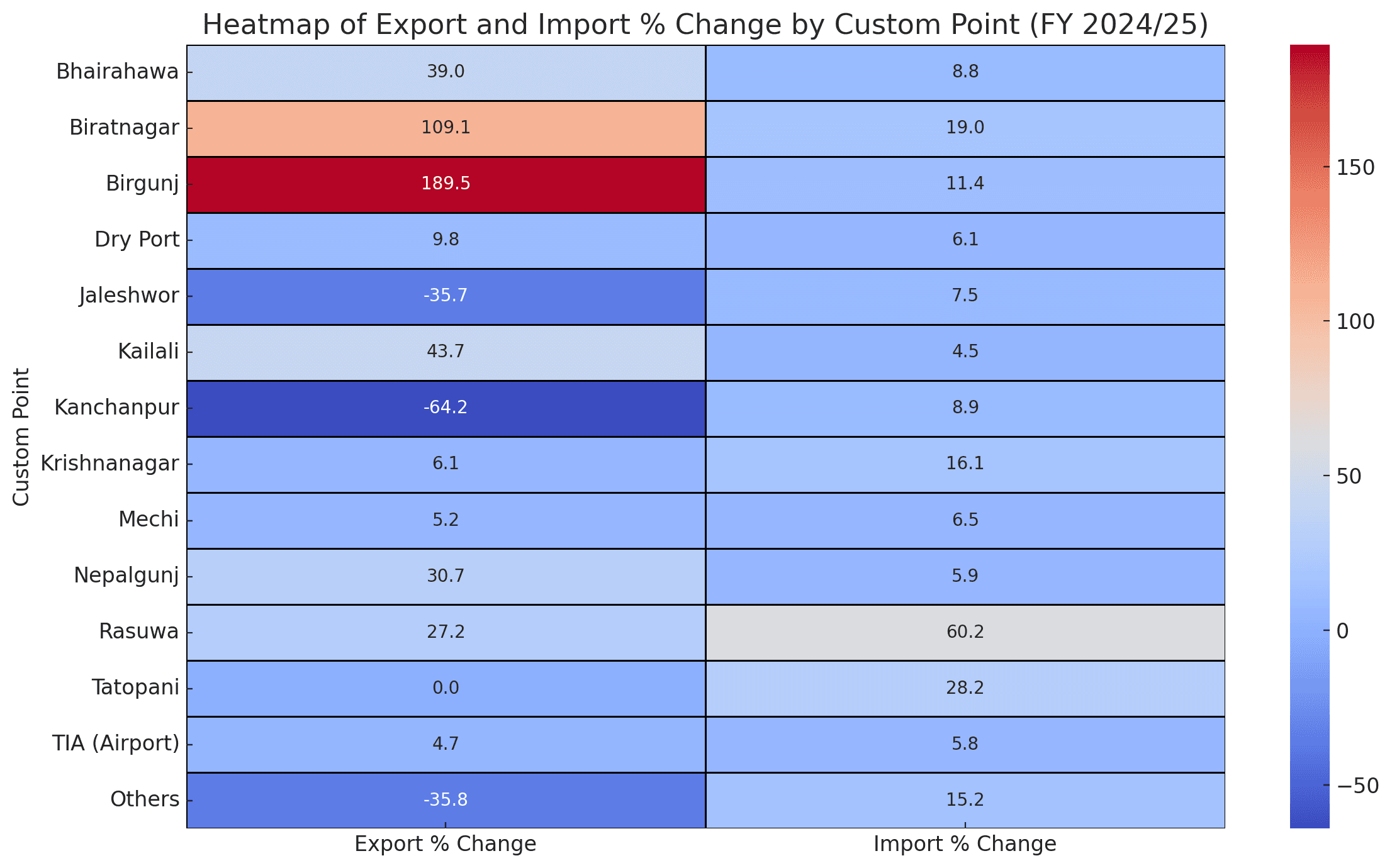
The highest growth in exports was recorded at the Birgunj Customs Office, with a staggering 189.5% increase, rising from Rs. 22.63 billion in 2023/24 to Rs. 65.51 billion in 2024/25. This office also leads in import volumes, reaching Rs. 447.99 billion, up by 11.4% from the previous year's Rs. 402.10 billion. Birgunj remains the nation’s most significant trade gateway, given its connectivity and infrastructure.
Biratnagar Customs Office followed with an impressive 109.1% increase in exports, rising from Rs. 23.16 billion to Rs. 48.42 billion. Imports also grew by 19%, reaching Rs. 150.73 billion. The growth reflects increased manufacturing activity and trade facilitation in the eastern corridor.
Bhairahawa Customs Office also performed strongly, with exports up by 39%, hitting Rs. 14.22 billion, and imports increasing by 8.8% to Rs. 195.49 billion. Similarly, the Rasuwa Customs Office witnessed a dramatic 60.2% surge in imports, the highest among all customs points, indicating rising trade with China through the northern border.
However, not all custom offices showed a positive trend. Jaleshwor Customs Office saw a 35.7% decline in exports, while Kanchanpur experienced a sharper 64.2% drop, indicating localized trade disruption or reduced commercial activity. Tatopani Customs Office showed zero exports for the period, reflecting either temporary suspension of export activities or logistical issues.
From an import perspective, Tatopani Customs Office marked a 28.2% increase, rising to Rs. 34.14 billion, underscoring the revival of trade through this Himalayan route after prior natural disasters and geopolitical interruptions.
On the air cargo side, Tribhuwan International Airport Customs Office saw moderate export growth of 4.7%, with exports totaling Rs. 26.82 billion. Imports also went up by 5.8%, reaching Rs. 108.62 billion, highlighting Kathmandu's continued role in high-value air freight movement.
Customs points such as Mechi, Krishnanagar, and Nepalgunj also posted moderate gains in both exports and imports, reflecting steady trade flows in those areas. "Others" category, which includes smaller customs points, showed a decline of 35.8% in exports but a healthy 15.2% growth in imports.
In conclusion, the overall trade landscape at Nepal's customs points shows dynamic changes, with exports gaining momentum especially in industrial and border zones. The government may look into enhancing infrastructure at underperforming points while capitalizing on the high-growth routes to improve trade balance and efficiency in the coming fiscal cycles.