By Sandeep Chaudhary
ATR Indicator – Measure Market Volatility Like a Pro
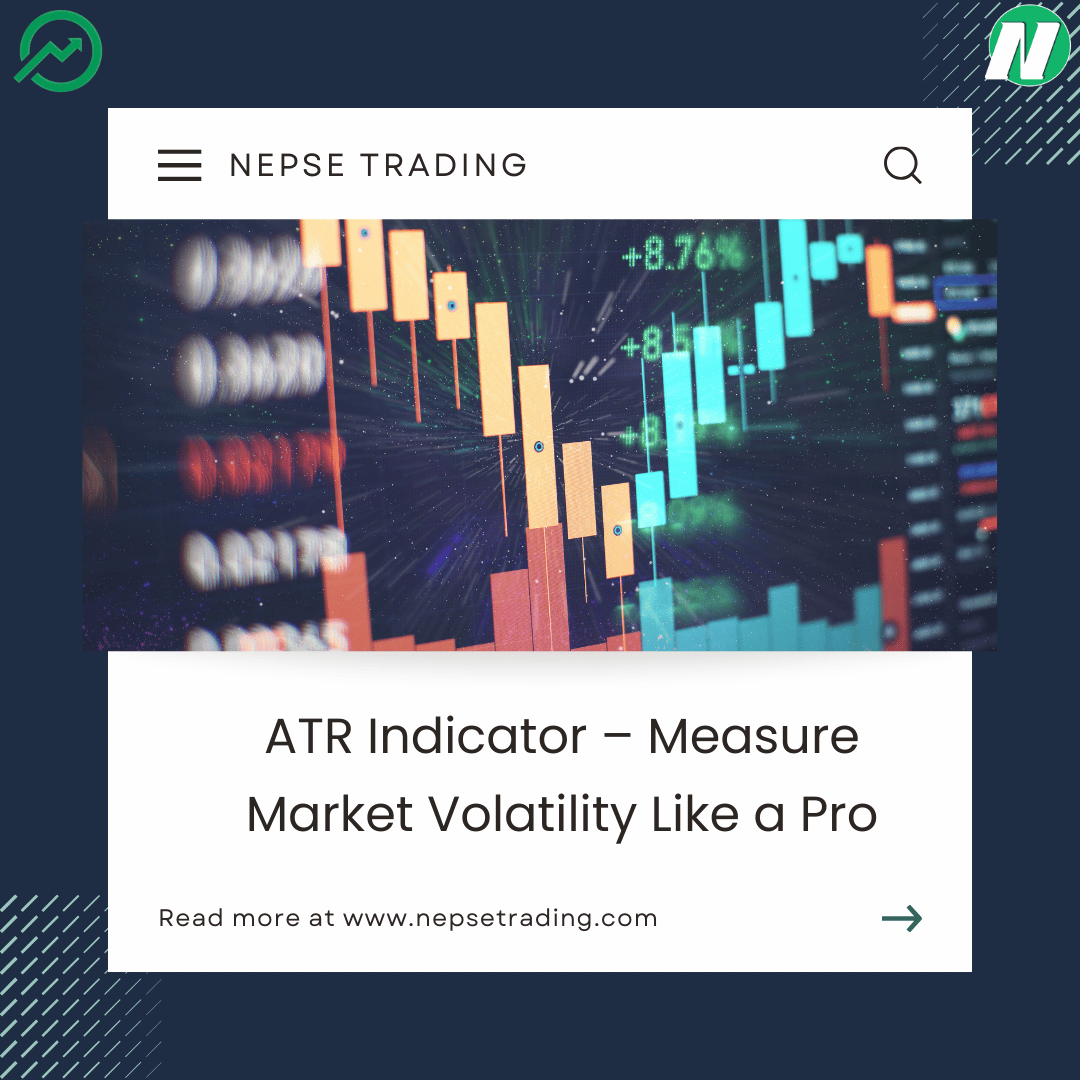
In professional Technical Analysis, the Average True Range (ATR) is one of the most powerful and essential indicators for measuring market volatility. Developed by J. Welles Wilder, ATR helps traders understand how much an asset typically moves within a given period, making it a key tool for determining stop loss, profit targets, and position sizing. For Nepali traders in the Nepal Stock Exchange (NEPSE), mastering the ATR indicator allows for accurate risk management and helps transform unpredictable market movements into structured, data-driven trading decisions.
Unlike momentum or trend indicators, ATR does not indicate market direction — it simply measures the degree of price fluctuation. A higher ATR value signifies higher volatility, meaning the price is moving more aggressively, while a lower ATR indicates a calm or consolidating market. This information allows traders to adjust their strategies according to market conditions. For instance, when the ATR rises sharply, it shows increased participation or possible breakout conditions; when it decreases, it suggests reduced market activity or consolidation.
The ATR is derived from the True Range (TR) — the largest of three values: (1) Current High minus Current Low, (2) the absolute difference between Current High and Previous Close, and (3) the absolute difference between Current Low and Previous Close. The average of these over a chosen period (commonly 14 days) gives the ATR value, representing the average daily volatility.
In NEPSE, the ATR is particularly useful during events like quarterly results, dividend declarations, or major economic announcements, where volatility increases dramatically. Smart traders use ATR to:
Adjust their stop losses according to volatility (usually 1–1.5× ATR away from entry).
Detect volatility breakouts, as sudden spikes in ATR often precede strong market moves.
Determine position size, reducing exposure when volatility is high and increasing it when stable.
Confirm trend strength, as rising ATR supports a strong trend while falling ATR signals possible weakening.
According to Sandeep Kumar Chaudhary, Nepal’s leading Technical Analyst and founder of NepseTrading Elite, “ATR is the radar of the trader — it doesn’t tell you the direction, but it tells you how fast and how far the market can move. Without knowing volatility, you’re trading blind.” With over 15 years of banking and trading experience, and technical training from Singapore and India, he teaches traders how to combine ATR, Price Action, Volume Analysis, and Smart Money Concepts (SMC) to build reliable, risk-managed trading systems for NEPSE.