By Dipesh Ghimire
Government Sets Up Irrigation Management Company to Operate Nepal’s First Large-Scale Mechanical Irrigation Program
In a major institutional reform aimed at modernizing Nepal’s agricultural infrastructure, the government has approved the establishment of Irrigation Management Company Limited, a new entity tasked with operating the country’s latest mechanical irrigation system. The Cabinet meeting held on Monday endorsed the proposal submitted by the Ministry of Energy, Water Resources and Irrigation, marking a significant step toward commercializing and expanding scientific irrigation in Nepal’s farmlands.
The new company will function as a multipurpose service provider and a productivity-oriented enterprise. Its ownership structure reflects a hybrid public–community investment model: the majority of shares will be held by the federal government, provincial governments, and local municipalities, with additional stakes allocated to farmers, agricultural financial institutions, private-sector entrepreneurs and the Nepal Electricity Authority (NEA). This diversified shareholder base, officials say, is designed to ensure both local participation and long-term sustainability of irrigation services.
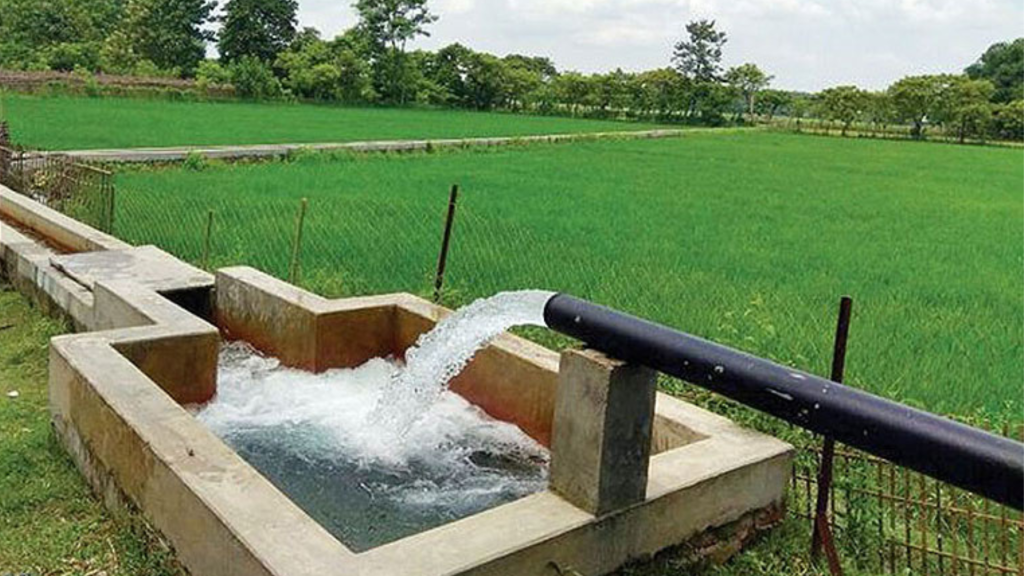
At the core of the company’s first operational mandate is the mechanical irrigation project currently being implemented in Rautahat and Sarlahi districts. Supported by government investment and Asian Development Bank (ADB) financing, the project plans to construct 500 deep tube wells in its initial phase, utilizing underground water sources to irrigate approximately 22,500 hectares of farmland. Energy and Irrigation Minister Kulman Ghising stated that the initiative is expected to significantly boost agricultural productivity, paving the way for commercial farming in regions long affected by unreliable water access.
Minister Ghising added that the mechanical irrigation model will be expanded to other districts as demand grows and technical feasibility allows. The government believes that a reliable and year-round irrigation system will be essential for agricultural modernization, addressing long-standing issues of monsoon dependency and crop vulnerability.
The project carries an estimated cost of USD 160 million (approximately NPR 22.4 billion). Of this, the government will contribute NPR 4.93 billion, while ADB will provide NPR 17.47 billion—including NPR 2.10 billion in grants and the remainder as concessional loans. Officials argue that such blended financing reduces fiscal burden while enabling the rapid development of large-scale infrastructure.
The Irrigation Management Company will have a broad operational mandate. It will manage surface and underground water systems, sign service agreements with farmers, determine water tariffs, collect irrigation fees, and oversee system operation, maintenance, and rehabilitation. Additionally, it will conduct farmer training and capacity development programs, ensuring that users can effectively adopt modern irrigation practices.
The company has been registered with an authorized capital of NPR 3 billion, divided into 30 million ordinary shares priced at NPR 100 per share. The initial issued capital will be NPR 20 million, of which 85 percent is allocated to founding shareholders, and 15 percent to general public shareholders linked to the project area.
Among the founders, the Ministry of Energy, Water Resources and Irrigation will hold 11 percent, while the Ministry of Finance, Ministry of Agriculture, and NEA will hold 10 percent each. The Madhesh Province government will own 15 percent, and the local governments of Rautahat and Sarlahi will collectively hold 25 percent. Agricultural Development Bank will contribute an additional 2 percent.
On the general shareholding side, agro-entrepreneurs of the project districts will receive 5 percent, while water-user farmer committees will hold 10 percent.
To ensure effective governance, the company will be overseen by a seven-member board of directors, comprising the Secretary of the Irrigation Division as Chair, the Director General of the Department of Irrigation, senior officials from the Ministries of Finance and Agriculture, representatives from the provincial and local governments, and one representative from farmer user groups. The Chief Executive Officer will serve as the board’s member-secretary.
Analysts note that the creation of a specialized irrigation company marks a strategic policy shift: Nepal is moving from fragmented, government-led irrigation schemes toward a corporatized, multi-stakeholder management model. The approach is expected to enhance accountability, improve service delivery, and reduce irrigation downtime—factors that have traditionally hindered Nepal’s agricultural output.
As the company enters its operational stage, stakeholders believe it could become a turning point in Nepal’s agricultural transformation. By replacing outdated irrigation practices with a modern, mechanized, and institutionally managed system, the government hopes to unlock new productivity potential in one of the country’s most crucial economic sectors.