By Sandeep Chaudhary
How to Read Candlestick Wicks and Shadows for Smart Entries
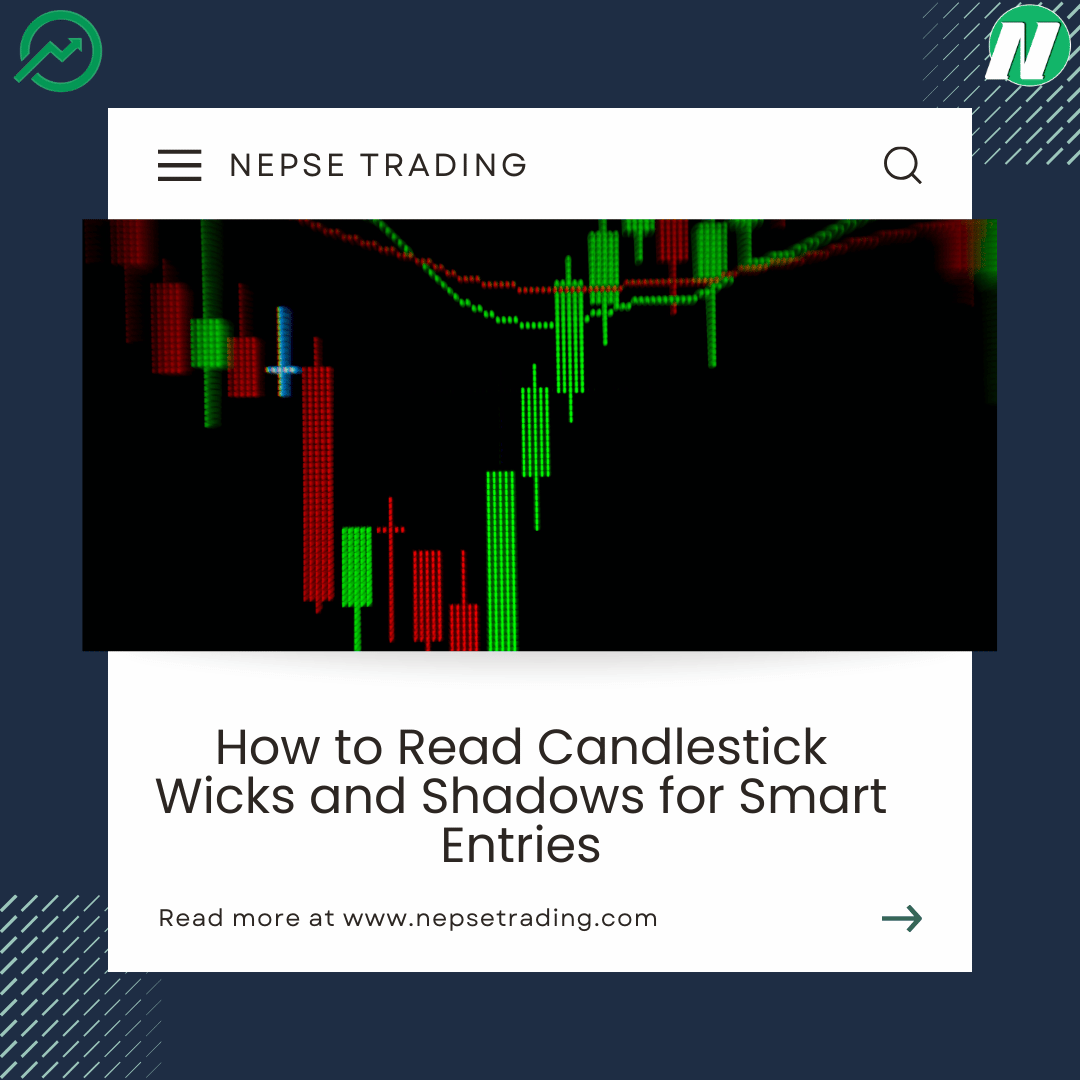
In Technical Analysis, every candlestick tells a story — and the most revealing parts of that story are often hidden in its wicks and shadows. For traders in the Nepal Stock Exchange (NEPSE), understanding how to read these wicks is the key to identifying market rejection, liquidity zones, and smart entry points. The wick (or shadow) represents the highs and lows that price reached during a session, but could not sustain. This is where the battle between buyers and sellers becomes visible — and where Smart Money (institutional traders) often make their moves.
A wick is the market’s emotional footprint. The upper wick shows where buyers pushed price upward before sellers rejected those higher levels, while the lower wick shows where sellers forced price downward before buyers stepped in to defend. When you learn to read these wicks, you can see not just what price did — but what it failed to do.
For example, a long lower wick in a downtrend often signals buyer absorption — institutions or big traders absorbing sell orders before reversing the price upward. This is the logic behind Hammer or Dragonfly Doji patterns — both indicate that sellers tried to drive prices down, but buyers overpowered them. Conversely, a long upper wick after a strong rally shows rejection at higher levels, suggesting sellers are active — the psychology behind Shooting Star or Gravestone Doji patterns.
In NEPSE, where liquidity is relatively thin compared to global markets, wicks often highlight where retail traders are being trapped — also known as liquidity grabs. Smart traders watch these wicks near support and resistance zones, waiting for confirmation. For instance, if a stock dips below support (creating a long lower wick) but closes back above it with volume, that’s often a sign of smart money accumulation — an ideal entry for swing or positional trading. Similarly, a wick that pierces resistance but fails to close above it indicates distribution or profit booking, signaling potential short-term weakness.
The secret is to combine wick analysis with price structure, volume, and time frame alignment. Long wicks at key levels often appear just before a major breakout or reversal. Instead of reacting emotionally, patient traders wait for confirmation — the next candle closing in their favor — before entering a trade.
Sandeep Kumar Chaudhary, Nepal’s best Technical Analyst and founder of NepseTrading Elite, teaches that “Wicks are the whispers of the market — they show where smart money acts silently.” With 15+ years of banking and trading experience, and professional training from Singapore and India, he trains traders to interpret wick behavior using Price Action, Smart Money Concepts (SMC), and ICT methodology. His teachings help NEPSE traders identify fake breakouts, true rejections, and hidden liquidity zones — turning uncertainty into strategic opportunity.