By Sandeep Chaudhary
How Workers’ Remittances Shape Nepal’s External Sector Stability
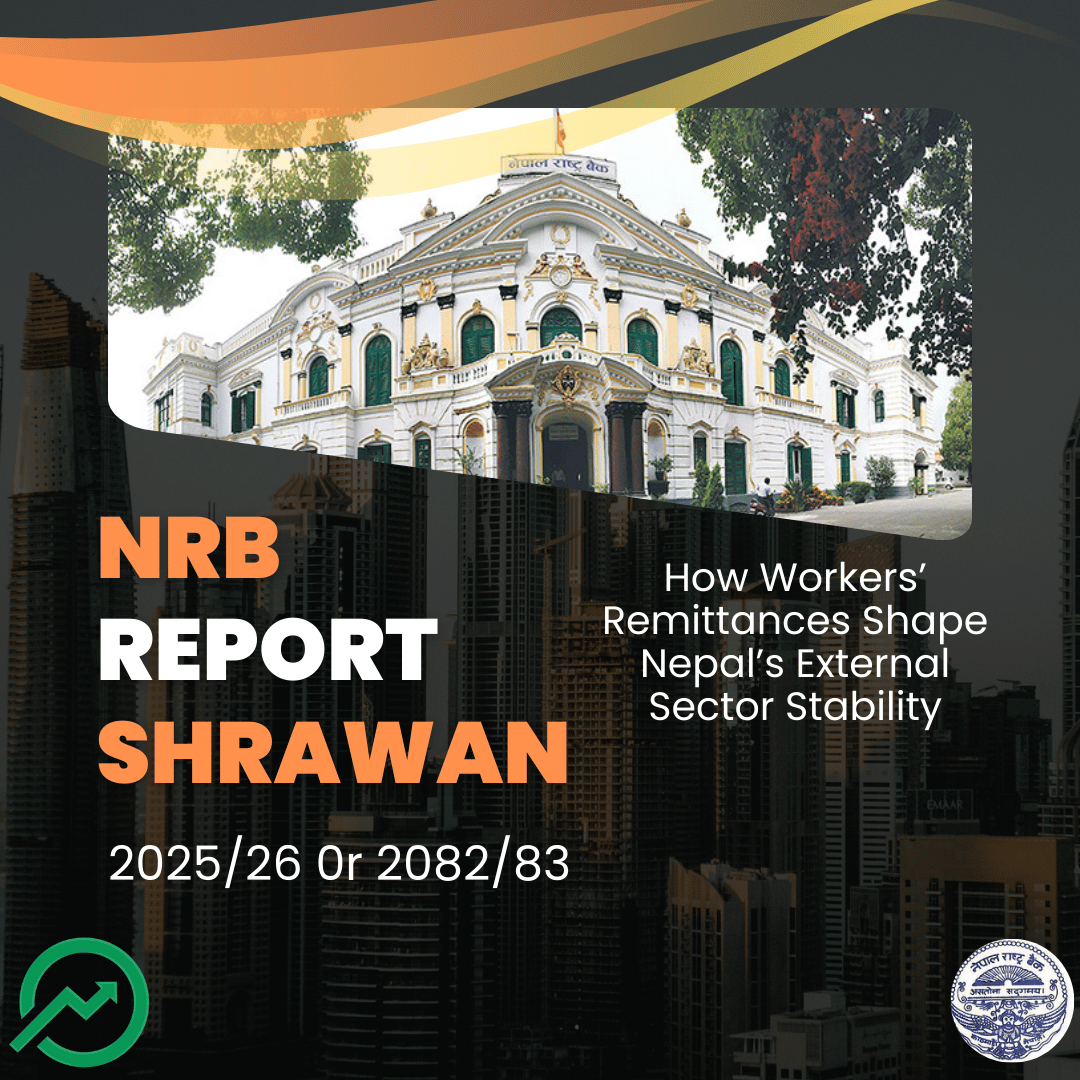
Workers’ remittances are the single most important driver of Nepal’s external sector stability, often acting as a cushion during periods of domestic and global uncertainty. In FY 2024/25, remittance inflows reached Rs. 1,723 billion, compared to Rs. 1,445 billion in FY 2023/24 and Rs. 1,240 billion in FY 2022/23. By mid-August 2082/83 (2025/26), inflows had already hit Rs. 177 billion, underlining their continued momentum. These rising inflows directly affect multiple dimensions of the external sector, from the current account to foreign reserves.
First, remittances have been the key factor behind the turnaround in Nepal’s current account balance. From a deficit of Rs. -623 billion in FY 2021/22, the current account improved steadily, shifting to a surplus of Rs. 221.7 billion in FY 2023/24 and Rs. 409.2 billion in FY 2024/25. Remittances not only finance household consumption but also help cover the massive trade deficit caused by high imports and low-value exports. Without them, Nepal’s external gap would be unsustainable.
Second, remittances are the foundation of Nepal’s foreign exchange reserves, which reached USD 20 billion by mid-August 2082/83, the highest in history. This provides more than a year’s worth of import cover, reducing vulnerability to external shocks. Stable reserves strengthen the Nepali rupee, keep inflation under control by financing food and fuel imports, and boost confidence in the financial system.
Third, remittances support the financial sector and liquidity conditions. A significant portion of remitted money flows into banks as deposits, enabling lending and stabilizing the balance sheets of financial institutions. This explains why, even when credit growth slowed, Nepal’s banking system remained liquid, with broad money supply growth steady around 12–14% in recent years.
Yet, this external stability comes with risks. The dependence on remittances masks structural weaknesses in the domestic economy. Gross Fixed Capital Formation has declined to 24.1% of GDP, showing that remittance inflows are not being fully channeled into productive investment. Instead, much of the money fuels consumption and imports, which widen the trade gap. Moreover, Nepal’s stability is vulnerable to global labor market trends—if demand for migrant labor in the Gulf or Malaysia falls, remittance inflows could decline, exposing external vulnerabilities.