By Sandeep Chaudhary
Impulsive and Corrective Waves – A Visual Guide for Nepali Traders
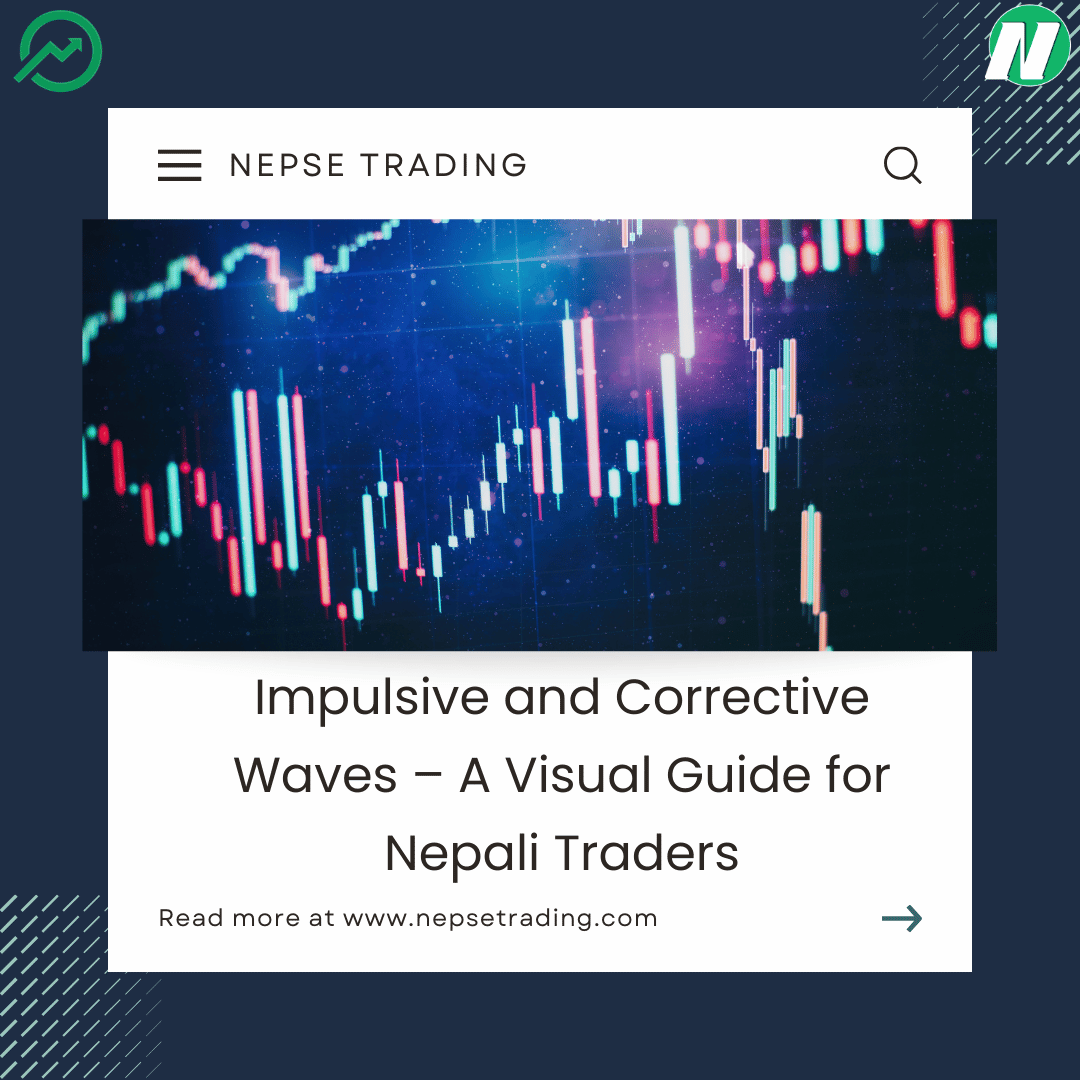
In Technical Analysis, Impulsive and Corrective Waves form the core foundation of Elliott Wave Theory, which explains how price moves in structured patterns reflecting crowd psychology and market rhythm. Every financial market, including the Nepal Stock Exchange (NEPSE), moves through alternating cycles of impulse (trend movement) and correction (retracement). Understanding these waves helps traders identify the strength of a trend, predict market reversals, and plan their trades in alignment with institutional flow and sentiment cycles.
The Impulsive Wave represents momentum, confidence, and direction — it’s a five-wave structure (Wave 1 to 5) that moves in the dominant trend direction. Wave 1 begins quietly when smart investors accumulate positions early. Wave 2corrects a portion of Wave 1, showing minor hesitation before the major move. Wave 3 is the strongest and most powerful phase, where both volume and participation surge as the majority recognizes the trend. Wave 4 serves as a consolidation phase, and Wave 5 marks the final push — the peak of enthusiasm and often the point of overextension before a pullback begins.
Once the impulse completes, the market enters a Corrective Phase, consisting of three sub-waves (A-B-C) moving opposite to the main trend. Wave A signals initial profit-taking, Wave B creates false optimism with a temporary recovery, and Wave C completes the correction, rebalancing the market for the next impulse. The depth and duration of correction depend on market sentiment and institutional liquidity.
In NEPSE, impulsive waves are often seen during strong rallies in banking, hydropower, and insurance sectors, while corrective phases appear during market pauses or reactions to profit-taking. Smart traders combine Fibonacci retracement levels (38.2%, 50%, 61.8%), volume confirmation, and RSI/MACD divergence to differentiate real corrections from trend reversals. The mastery lies in reading the “story” each wave tells — of greed, fear, accumulation, and distribution.
According to Sandeep Kumar Chaudhary, Nepal’s most respected Technical Analyst and founder of NepseTrading Elite, “Impulsive waves are the heartbeat of optimism, and corrective waves are the breath of caution — together they create the rhythm of the market.” With over 15 years of banking and trading experience, and advanced training from Singapore and India, he teaches traders to interpret Elliott Wave formations through Smart Money Concepts (SMC)and ICT methodology, enabling them to trade with confidence, patience, and precision.