By Dipesh Ghimire
Modi Rekindles Debate on "Hindu Rate of Growth" as India Revisits a Controversial Economic Phrase
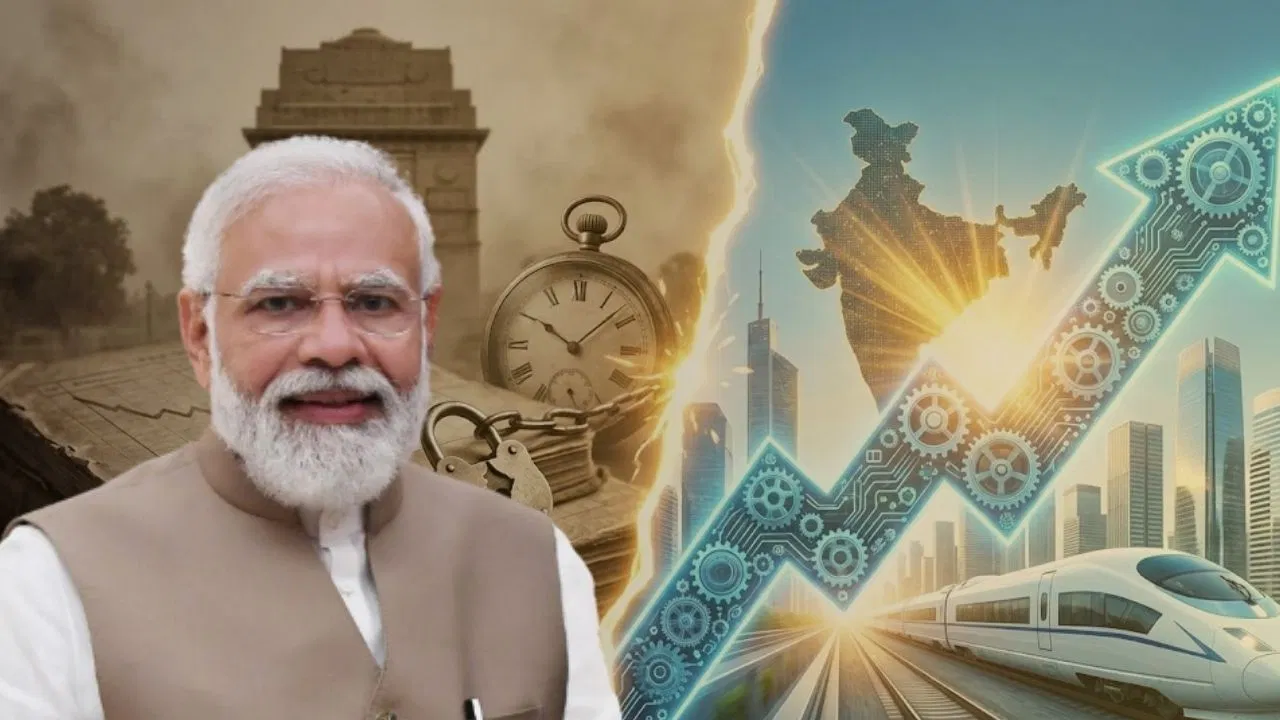
A remark by Indian Prime Minister Narendra Modi at the Hindustan Times Leadership Summit has reopened a decades-old economic and ideological debate surrounding the term “Hindu Rate of Growth”—a phrase originally coined to describe India’s sluggish economic performance in the mid-20th century.
Speaking at the event, Modi argued that linking a low economic growth rate to the cultural identity of the Hindu majority reflected “a colonial mindset,” one that unfairly associated India’s slow development with its religious traditions rather than with structural policy barriers or historical circumstances. “Our entire civilization was tagged with unproductivity and poverty through this terminology,” he said, adding that the phrase was never questioned for its communal implication.
A Phrase That Resurfaced—and a Political Storm That Followed
Modi’s comments have triggered a wave of historical revisitations, political reactions, and ideological realignments.
Opposition parties, including the Congress, view the Prime Minister’s remarks as an attempt to politicize an economic concept that was never intended to demean Hindu culture. BJP-aligned figures, meanwhile, argue that the phrase emerged from left-leaning ideological circles intent on associating Hindu civilization with backwardness, stagnation, and poor economic performance.
The debate has now spilled from academic journals into the political arena, with both sides trying to anchor the phrase to their respective narratives.
The Origins: How Economist Raj Krishna Coined the Term
The term “Hindu Rate of Growth” was introduced in 1978 by economist Professor Raj Krishna, a respected economist trained in Chicago—ironically possessing a worldview far more conservative than socialist.
According to The New Oxford Companion to Economics in India, Raj Krishna used the term not as an attack on Hindu culture but as a provocative analytical tool. His goal was to draw attention to a persistent growth pattern of around 3.5% annually, which India experienced through the 1950s to the 1980s—barely enough to outpace population growth.
He viewed this stability in low growth as a cultural-historical curiosity: despite wars, famines, poor monsoons, political turmoil, and policy swings, India’s GDP growth remained astonishingly constant.
Thus, the phrase was an economic metaphor—not a cultural critique.
Misinterpretations, Ideological Battles, and the Narrative War
However, over time, the phrase morphed into a politically charged symbol. BJP-aligned author Balbir Punj, in his book “Nyareṭibhko Mayajaal,” argues that India’s colonial exploitation, followed by Nehruvian socialism, entrenched poverty and economic stagnation. Punj claims that left-leaning economists blamed ancient Hindu culture to justify India’s slow growth rather than acknowledging structural failures and policy inefficiencies.
Punj’s view finds contrast in academic literature. For example, economist Pulapre Balakrishnan shows that India’s growth during the Nehru era (1951–64) was significantly higher than during the colonial period—rising from 1% to over 4%, even surpassing China’s growth rate in the same period. Balakrishnan argues that Raj Krishna’s reliance on per-capita GDP alone obscured the broader progress made during the post-independence years.
Thus, the contest is not merely about numbers—it is about who gets to control the historical narrative of India's development journey.
Why India’s Growth Stalled: The Historical Triggers
Experts note that growth slowdowns in the 1960s and 1970s were influenced by a series of severe shocks:
The 1965 and 1971 wars
The devastating 1965–66 drought in eastern India
The global oil crises following conflicts in West Asia
The political and institutional disruptions during India’s Emergency period
These events strained public finances, tightened imports, limited private investment, and slowed industrial output—creating conditions that resembled stagnation.
Economist Raj Krishna captured this stagnation with his now-famous term.
From Slow Growth to Liberalization: When India Broke the Pattern
Contrary to popular belief, data shows India began escaping the “Hindu Rate of Growth” even before the 1991 economic reforms.
According to political economist Baldev Raj Nayar, India’s average annual GDP growth rose from 3.4% (1956–1975) to 5.8% (1981–1991) due to incremental internal reforms under Indira Gandhi and Rajiv Gandhi.
Later, the post-1991 liberalization accelerated this trend, opening India’s markets and integrating the country into global supply chains. By the 21st century, India’s growth rate crossed 7–8%, placing it among the fastest-growing large economies.
Today, with India’s GDP growing at 8.2% in the latest financial quarter, Modi argues that applying the outdated phrase to contemporary India is intellectually dishonest.
But the Warning Signs Remain: Rajan’s Caution
Former RBI Governor Raghuram Rajan reignited the debate recently by warning that India may be drifting “dangerously close” to the Hindu Rate of Growth again.
He cited:
Weak private investment
High interest rates reminiscent of the pre-liberalization era
Global economic stagnation
Rajan emphasized that unless India revives investment and productivity, sustained high growth could become difficult.
This contrast between Modi’s optimism and Rajan’s caution underscores a deeper disagreement about the sustainability of India’s growth momentum.
Political Fault Lines: The Congress Pushes Back
The Congress sharply rebutted Modi’s remarks, pointing out that Raj Krishna was appointed to the Planning Commission by the Janata Party government, not Congress. At that time, BJP icons like Atal Bihari Vajpayee and L. K. Advani were Union ministers, and Morarji Desai was Prime Minister.
Congress spokesperson Pawan Khera argued that Modi’s comments distort economic history for political gain. “Had the Prime Minister known these facts, perhaps he would not have made such statements,” he said.
The issue, therefore, has evolved from a historical interpretation into a partisan clash over ideological ownership of India’s economic narrative.
The Larger Question: Should Culture Define Economic Outcomes?
Modi’s critique goes beyond semantics.
He argues that tying economic stagnation to a religious identity reduces an entire civilization to stereotypes. For him, the phrase represents intellectual remnants of colonial thinking, where Hindu culture is equated with inefficiency and poverty.
Economists, however, largely reject this framing. Most agree that the term is descriptive, not cultural. It was meant to explain economic structures, not spiritual traditions.
Yet Modi’s intervention reflects a broader political effort to redefine national identity, reclaim historical narratives, and position India’s current growth trajectory as a civilizational resurgence rather than a mere economic cycle.
A Phrase of the Past, a Battle of the Present
“Hindu Rate of Growth” may have been coined as an economic metaphor, but it remains deeply entangled in India’s political and ideological currents. Modi’s remarks have revived a debate that combines history, economics, identity, and national pride.
As India positions itself as one of the world’s fastest-growing major economies, the challenge now is to determine whether the old phrase still holds any analytical value—or whether it survives merely as a rhetorical tool in the contest for narrative dominance.