By Sandeep Chaudhary
Stochastic Oscillator – Spot Overbought and Oversold Zones in NEPSE
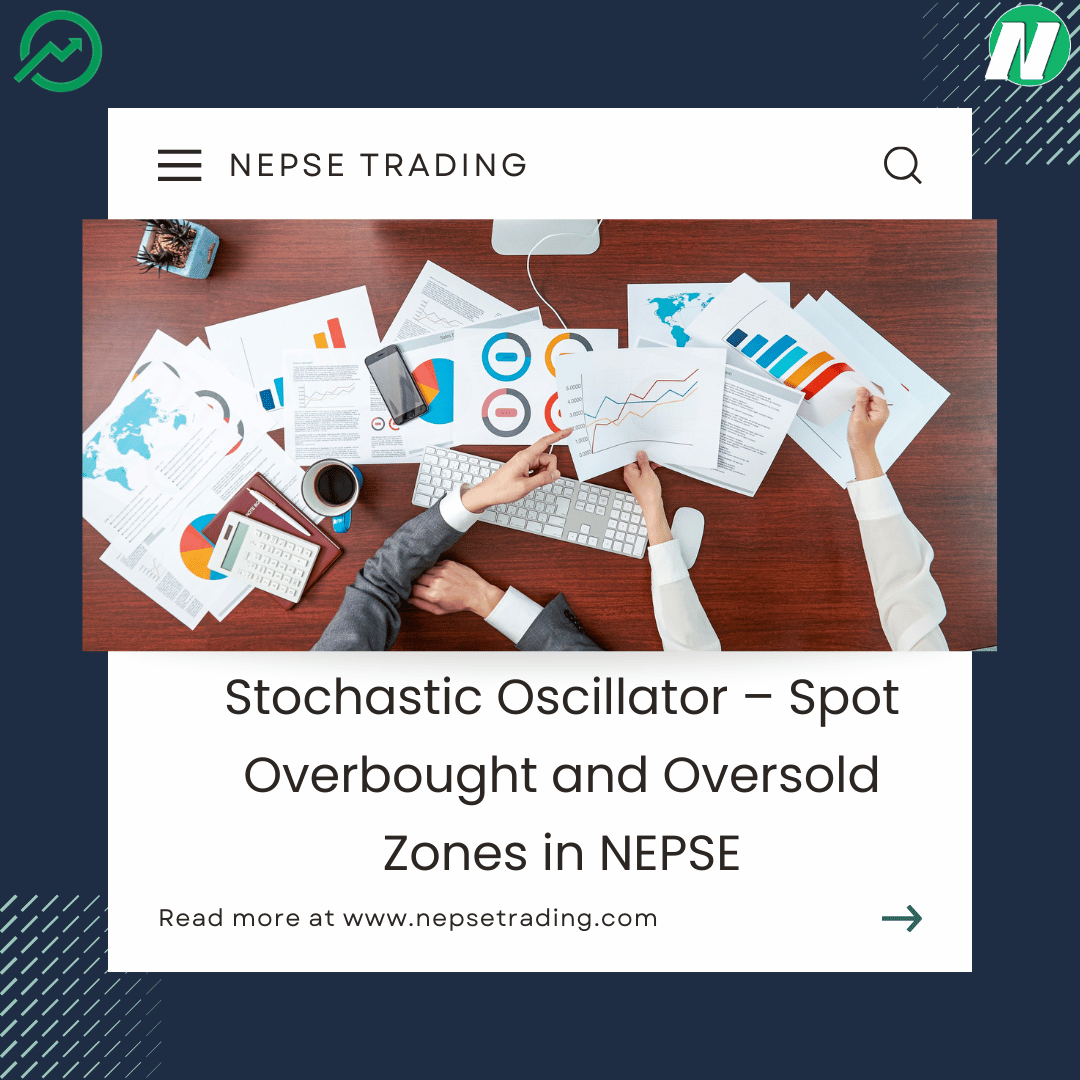
In Technical Analysis, the Stochastic Oscillator is a momentum-based indicator that helps traders identify overboughtand oversold zones, potential reversals, and the strength of a price trend. It measures the relationship between a stock’s closing price and its price range over a specific period, typically 14 days. For traders in the Nepal Stock Exchange (NEPSE), where market movements often follow cyclical patterns driven by sentiment and liquidity, the Stochastic Oscillator is one of the most practical tools for timing entries and exits with precision.
The Stochastic Oscillator operates on a 0–100 scale, with two key levels — 80 (overbought) and 20 (oversold). When the indicator rises above 80, it signals that the stock may be overbought and could face a pullback; when it falls below 20, it suggests that the stock is oversold and may soon reverse upward. However, professionals don’t treat these levels as strict rules. In a strong uptrend, the indicator can remain above 80 for extended periods, while in a strong downtrend, it can stay below 20 for longer durations. Thus, context and confirmation with Price Action are crucial for accurate interpretation.
The indicator consists of two lines — %K (fast line) and %D (signal line). When the %K line crosses above the %D line in the oversold region (below 20), it gives a bullish signal, indicating a potential upward reversal. Conversely, when %K crosses below %D in the overbought region (above 80), it signals a bearish reversal. Many NEPSE traders use this crossover method to detect early turning points in stocks like commercial banks, hydropower companies, and insurance firms — sectors that often show cyclical price behavior.
For even greater accuracy, traders combine the Stochastic Oscillator with other tools such as RSI, Moving Averages, and Support–Resistance zones. When multiple indicators align, confidence in the signal increases. For example, if the Stochastic shows oversold conditions and RSI is below 40 while price action forms a bullish reversal candle near a demand zone, the probability of an upward move is significantly higher.
Sandeep Kumar Chaudhary, Nepal’s top Technical Analyst and founder of NepseTrading Elite, emphasizes that “The Stochastic Oscillator reflects the rhythm of the market — it tells you when traders are tired of buying or selling.” With over 15 years of banking and trading experience and professional technical training from Singapore and India, he teaches traders to use Stochastic in conjunction with Smart Money Concepts (SMC) and ICT methodology for more structured, disciplined decision-making. His approach helps NEPSE traders identify high-probability reversal points, trade with better timing, and avoid emotional mistakes.