NEPSEtrading

Make smarter moves backed by machine learning. Join thousands of traders leveraging AI to maximize profits.

nepsetrading.com is an online news portal that provides insights into trading and investment by analyzing the stock market and the global economy. We create charts based on the analysis of various indicators. Please do not rely solely on this information for investment decisions. Self-study is crucial. Use this information only as an educational and informational resource.

Marketminds Investment Group Private Limited

DOIB Registration certificate no. :

4680-2081/2082

Chairman: Bishal Bikram Bimali

Director and Editor-in-chief:

Dipesh Ghimire

(

9802363868,

9851119988

)

Koteshwor 32 , Kathmandu

01-5253221

+977 9709066745

Contact support

Subscribe to our newsletter

Weekly insights from the NEPSE market in your inbox.

Market

StocksSectors

Company

About UsOur TeamTerms of UseOur PolicyTrainingContact Us

Help

SupportReportFAQ

© 2026 nepsetrading.com. All rights reserved.
This website is owned and operated by Marketminds Investment Group Private Limited.

Charts are powered byTrading View

NEPSEtrading

  • Home
  • Market
  • NEPSE Overview
  • Charts
  • News
  • Blogs
  • Training
  • Pricing
  1. Blogs
  2. Global payments
  3. Visa Bets Long Term on Nepal as the Economy Inches Away from Cash
Global payments

Visa Bets Long Term on Nepal as the Economy Inches Away from Cash

The real test, then, is maturity rather than momentum. By Visa's own yardstick, the market will have come of age when consumers transact digitally with full confidence, businesses accept payments without friction, and the system's records start translating into credit, formalization and deeper participation in the economy. If Nepal gets that right, the company argues, the payoff will reach well beyond the financial sector — stronger businesses, wider access and an economy more firmly connected to the world. The direction is promising; the hard part is the plumbing, and the trust.

DGDipesh Ghimire
Published on June 4, 20264 min read
Visa Bets Long Term on Nepal as the Economy Inches Away from Cash

Global payments giant Visa is framing Nepal as a long-term strategic market, arguing that the country's payments landscape is entering a decisive new phase — one that will be defined less by how many people adopt digital payments than by how confidently they use them in daily economic life. The assessment comes in a commentary published by the company outlining its view of Nepal's digital transition and its own role in it.

Cash, Visa notes, has long sat at the center of how Nepal's economy runs — shaping how businesses operate, how trust is built in the marketplace, and how much of the economy stays informal. That equation, the company argues, is now shifting. As mobile banking, cards, wallets and other electronic transactions become routine for households and businesses — and spread well beyond the cities — the economy is becoming more transparent, more networked and more credible. Businesses, it says, are seeing the gains most clearly in efficiency, transparency and day-to-day operations, while coordination among regulators, financial institutions and innovators has given the shift added momentum.

The economic logic behind that claim is worth unpacking. Every digital transaction leaves a record that a cash payment does not. In an economy where a substantial share of activity happens informally, those records are the raw material of formalization: they widen the visible tax base, make business performance measurable, and create the data on which credit decisions can rest. In other words, the payments shift Visa describes is not merely a convenience story — it is a route by which more of Nepal's economy becomes legible to its financial system.

Notably, the company tempers its own optimism. The market, it concedes, is still at an early stage: cash continues to dominate daily life, many businesses are not yet fully equipped to accept digital payments, and consumer confidence in electronic transactions is still being built. The next step, in Visa's telling, is not simply wider usage but a system that works better for everyone — trusted, broadly accepted and capable of supporting larger economic activity.

A second strand of the argument concerns Nepal's deepening global ties. With large numbers of Nepalis working, studying and living abroad while staying financially connected to home, tourism bringing the world in, and businesses and IT professionals plugging into international trade and services, Visa contends that a payments system that works only locally is no longer enough — it must connect seamlessly with the rest of the world. The interpretation is hard to argue with: in an economy where remittance inflows underpin household consumption — a dependence Nepal Rastra Bank itself has repeatedly flagged — the rails that move money across borders are not a convenience but core economic infrastructure.

The commentary's most consequential point may be about small and medium enterprises. Many capable SMEs, Visa observes, struggle to obtain credit because they cannot demonstrate steady cash flow or document their business discipline in a form lenders can assess. A robust digital payments environment, it argues, can change that by creating clear records of economic activity, enabling better risk assessment and improving access to finance. Read closely, this is a case for moving Nepali lending away from its heavy reliance on collateral and toward cash-flow-based credit — arguably the single biggest prize of payment digitization for the real economy.

On its own role, Visa is keen to stress that it is now far more than a card brand. Operating across more than 200 countries and territories, it describes itself as a connector of consumers, merchants, banks, businesses and public institutions, and positions itself as a bridge between Nepal's domestic payments ecosystem and the global market. Tools such as Visa Direct, which enables fast and secure transfers into bank accounts, are pitched as directly relevant to Nepal's remittance and business-payment flows.

The company's commitment has already taken concrete form. Visa opened an office in Kathmandu and appointed Manoj Thapa — previously head of partnerships and innovation at domestic payments network Fonepay — as its Head of Nepal, signaling that its talk of a "long-term commitment" is backed by an on-the-ground presence rather than remote servicing.

Visa is careful, too, to frame the road ahead as a collective effort: banks, financial institutions, fintechs and domestic payment networks working together to grow acceptance, improve interoperability and strengthen trust, with Visa contributing global expertise and local focus. That framing matters, because Nepal already has dense home-grown payment rails of its own. The open question for the next chapter — one Visa itself names — is interoperability: how smoothly global networks and domestic systems mesh, so that users move money without worrying about which rail carries it.

The real test, then, is maturity rather than momentum. By Visa's own yardstick, the market will have come of age when consumers transact digitally with full confidence, businesses accept payments without friction, and the system's records start translating into credit, formalization and deeper participation in the economy. If Nepal gets that right, the company argues, the payoff will reach well beyond the financial sector — stronger businesses, wider access and an economy more firmly connected to the world. The direction is promising; the hard part is the plumbing, and the trust.

DG

Written by

Dipesh Ghimire

Visa Bets Long Term on Nepal as the Economy Inches Away from Cash

Related News

View all
  • Excise Out, New Fee In: Nepal's EV Tax Overhaul Hits the Middle-Class Buyer Hardest
    Nepal's EV Tax

    Excise Out, New Fee In: Nepal's EV Tax Overhaul Hits the Middle-Class Buyer Hardest

    4 Jun, 2026

  • Non-Life Insurance Stocks Rally as Budget Doubles Third-Party Motor Cover
    Non-Life Insurance

    Non-Life Insurance Stocks Rally as Budget Doubles Third-Party Motor Cover

    4 Jun, 2026

  • Nepal's Infrastructure Reckoning: Big Budget, Bigger Expectations
    editorial

    Nepal's Infrastructure Reckoning: Big Budget, Bigger Expectations

    3 Jun, 2026

Related News

Excise Out, New Fee In: Nepal's EV Tax Overhaul Hits the Middle-Class Buyer Hardest
Nepal's EV Tax

4 min read

Excise Out, New Fee In: Nepal's EV Tax Overhaul Hits the Middle-Class Buyer Hardest

NADA's Upreti argues the market can absorb the higher taxes — on one condition. "Consumer purchasing power has to grow. Capital spending must rise to get money circulating in the market," he says. "If the domestic market gets moving, it energizes the entire sector." In other words, whether this tax overhaul dents Nepal's EV boom or merely skims revenue off it will depend less on the rates themselves than on whether the government spends its budget fast enough to keep buyers walking into showrooms.

Dipesh Ghimire

·

4 Jun, 2026

Non-Life Insurance Stocks Rally as Budget Doubles Third-Party Motor Cover
Non-Life Insurance

3 min read

Non-Life Insurance Stocks Rally as Budget Doubles Third-Party Motor Cover

There is also a side of the equation the share market does not trade: the policy's real-world trade-off. Vehicle owners face renewals that could cost 30 percent more, while victims of road accidents gain access to a compensation pool twice as deep. Whether the budget provision proves a windfall for insurers, a burden for motorists or simply better protection for the public will become clear only once the rate committee puts a number on it.

Dipesh Ghimire

·

4 Jun, 2026

Nepal's Infrastructure Reckoning: Big Budget, Bigger Expectations
editorial

5 min read

Nepal's Infrastructure Reckoning: Big Budget, Bigger Expectations

The Rs 303 billion allocation is, by itself, neither a solution nor a guarantee. It is an opportunity. Whether Nepal converts it into durable highways, reliable electricity, functional irrigation, and connected cities — or watches it dissolve in administrative delays, monsoon-season shortcuts, and political deal-making — will depend on decisions made in the months ahead. The foundation of Nepal's economic future is being poured right now. The question is whether it will hold.

Dipesh Ghimire

·

3 Jun, 2026

Big Promises, Smaller Share: How the Budget Fell Short of the RSP's Education Pledges
Budget 2084/84

3 min read

Big Promises, Smaller Share: How the Budget Fell Short of the RSP's Education Pledges

The shortfall looks starker still against Nepal's own international commitments. The country has repeatedly pledged on global platforms to devote 20 percent of the national budget (or 5 percent of GDP) in education, but successive governments have failed to live up to the commitment. With the share stuck around 10-11 percent for years and now at roughly 10.28 percent — and amounting to less than 3 percent of the GDP — the new government has landed at about half of what it had promised the world, let alone its own voters.

Dipesh Ghimire

·

2 Jun, 2026

Why NEPSE's Optimism Keeps Flickering Out — and Why the Budget Couldn't Light It
NEPSE

5 min read

Why NEPSE's Optimism Keeps Flickering Out — and Why the Budget Couldn't Light It

Seen as a whole, the past few months describe a market whose direction is dictated by political and policy signals — arrests, ministerial reassurances, budget clauses — rather than by the performance of listed companies. Confidence stays brittle precisely because the recurring sources of fear, namely regulatory and legal risk on one side and tax uncertainty on the other, keep resurfacing just as optimism builds. The budget was meant to be the catalyst that finally lifted sentiment for good; instead it stacked a tax increase on top of an unresolved question, leaving the rally hostage to a clarity that has yet to fully arrive. Until that clarity comes — in unambiguous implementation of the final-tax provision and a steadier regulatory climate — NEPSE's enthusiasm looks set to keep flaring up and fading away.

Dipesh Ghimire

·

2 Jun, 2026

6,300 Savers, Rs 4.77 Billion: Kathmandu's Cooperative Distress Comes Into Focus
Cooperative

4 min read

6,300 Savers, Rs 4.77 Billion: Kathmandu's Cooperative Distress Comes Into Focus

In the end, the Kathmandu numbers are less a standalone event than a barometer. They show, in concentrated form, both the depth of public anxiety over cooperative savings and the slow, recovery-dependent nature of any fix. Whether confidence can be rebuilt will depend on the one thing these figures cannot yet demonstrate at scale: money actually moving back into depositors' hands.

Dipesh Ghimire

·

2 Jun, 2026

From Power to Price: New EV Tax Closes One Loophole but Opens Several Others
EVs Luxury Models Taxed Up to

5 min read

From Power to Price: New EV Tax Closes One Loophole but Opens Several Others

Up to Rs 20 lakh: 20% customs + 2.5% infrastructure fee Rs 20-30 lakh: 20% customs + 20% infrastructure fee Rs 30-40 lakh: 20% customs + 35% infrastructure fee Rs 40-50 lakh: 20% customs + 90% infrastructure fee Above Rs 50 lakh: 20% customs + 130% infrastructure fee

Dipesh Ghimire

·

2 Jun, 2026

Cheap EVs Kept Affordable, Luxury Models Taxed Up to 195%: Govt Retains Price-Based EV Tax Wall
EV

3 min read

Cheap EVs Kept Affordable, Luxury Models Taxed Up to 195%: Govt Retains Price-Based EV Tax Wall

The larger takeaway is that Nepal's EV tax regime is not a single policy but two policies stitched together: a genuine incentive at the bottom of the price ladder and a heavy deterrent at the top. Whether that balance holds, or whether sustained pressure from the trade eventually softens the upper tiers, is likely to be one of the recurring debates in the country's electric-vehicle market in the year ahead.

Dipesh Ghimire

·

2 Jun, 2026

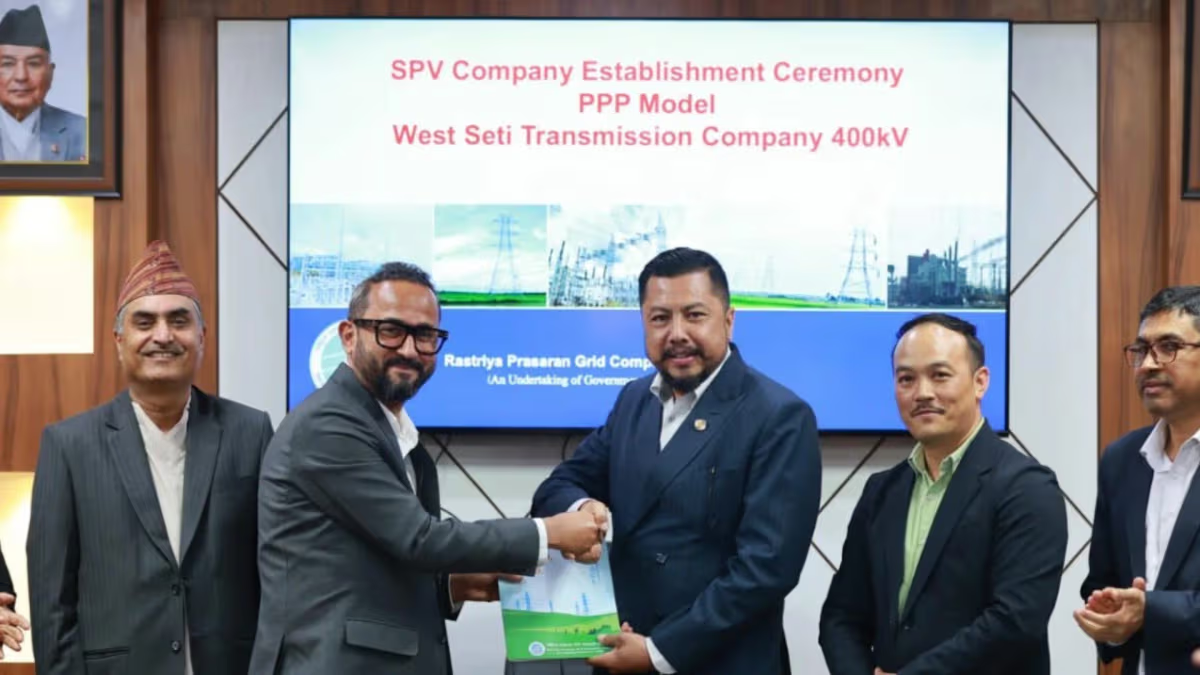
Private Capital Enters Nepal's Power Grid: West Seti 400 kV Line Marks a Structural Shift
West Seti 400 kV

4 min read

Private Capital Enters Nepal's Power Grid: West Seti 400 kV Line Marks a Structural Shift

Taken together, the project is being viewed as an important milestone in the development of Nepal's transmission infrastructure — both for the precedent it sets in private participation and for the role it could play in turning the far-west into a genuine power-generating region rather than one whose rivers run untapped.

Dipesh Ghimire

·

2 Jun, 2026