Inflation
·

By Sandeep Chaudhary

Nepal's Inflation Falls to 2.72% in Mid-June 2025, Lowest in Five Years
Nepal's Inflation Falls to 2.72% in Mid-June 2025, Lowest in Five Years

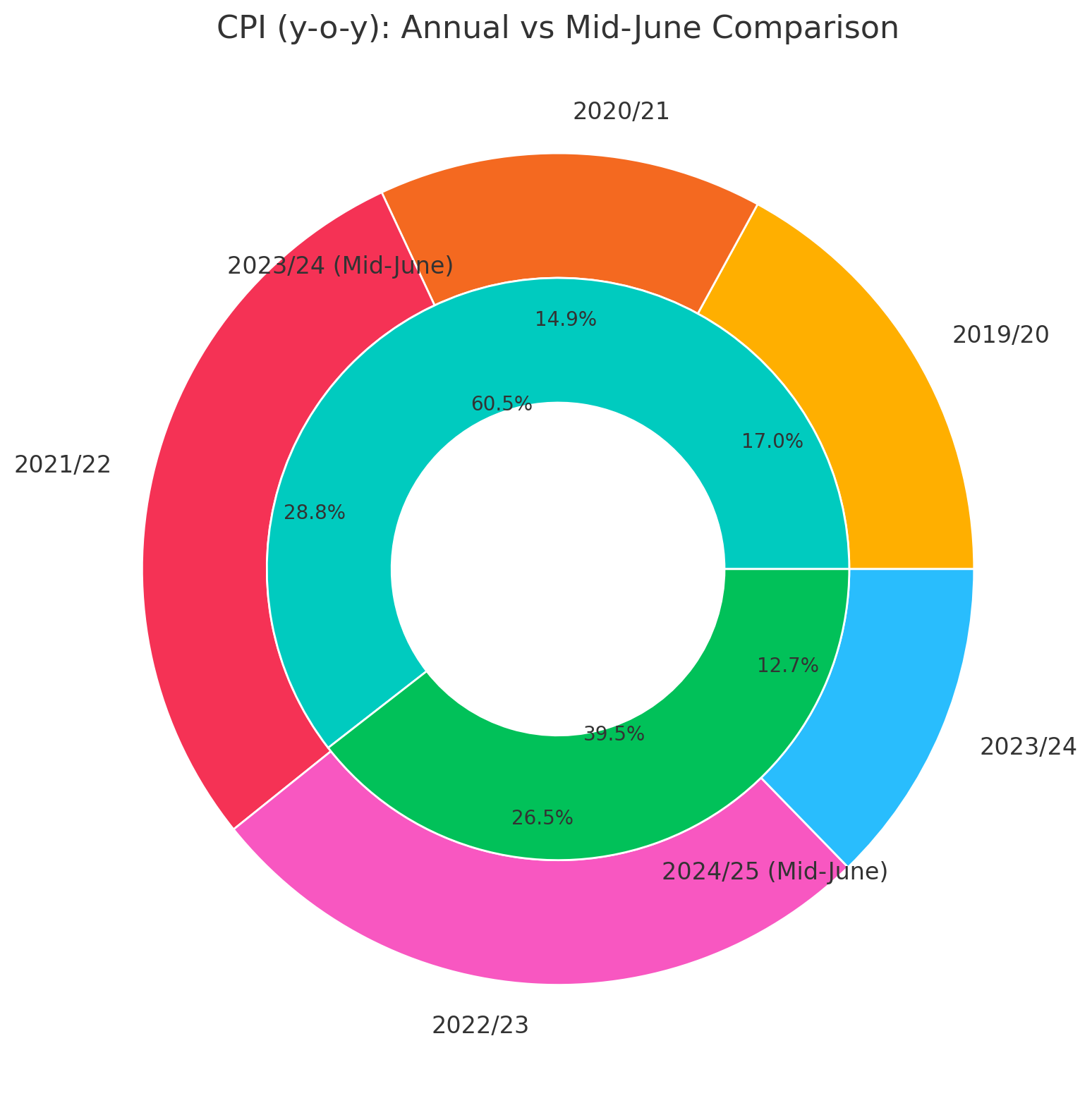
Nepal's consumer inflation rate has shown a significant decline, reaching a five-year low of 2.72% year-on-year (y-o-y)by mid-June 2025, according to data released by Nepal Rastra Bank. This marks a sharp drop from 4.17% recorded in mid-June 2024 and a substantial decrease from 3.57% observed in the annual average for FY 2023/24.

The broader trend over the past few years reveals a fluctuating inflation pattern. In FY 2019/20, the Consumer Price Index (CPI) stood at 4.78%, which slightly decreased to 4.19% in FY 2020/21. However, inflation surged to 8.08% in FY 2021/22—driven by post-pandemic supply chain disruptions and global commodity price shocks—before easing to 7.44% in FY 2022/23. The trend sharply reversed in FY 2023/24, with the annual CPI falling to 3.57%, suggesting a return to monetary stability.

The continued drop in inflation through mid-June 2025 signals a more stable macroeconomic environment. Factors contributing to this trend include improved domestic production, easing import costs due to stronger currency reserves, and tighter monetary policy by the central bank.

This low inflation figure is particularly important as it provides relief to households facing high living costs in previous years and supports purchasing power recovery. However, policymakers must remain cautious to ensure inflation remains within a healthy range that supports both consumer welfare and sustainable economic growth.
Related Blogs

Nepal Begins Budget Work, Sets Up Revenue Advisory Committee to Shape Tax and Economic Reforms
Top

4 min read

Nepal Begins Budget Work, Sets Up Revenue Advisory Committee to Shape Tax and Economic Reforms

Nepal Begins Budget Work, Sets Up Revenue Advisory Committee to Shape Tax and Economic Reforms Kathmandu — Nepal’s Ministry of Finance has formally kicked off the process of preparing the national budget for the upcoming fiscal year by constituting a Revenue Advisory Committee, signaling the start of the government’s annual fiscal planning cycle. Officials say the move is aimed at collecting structured policy input before the budget ceiling, priorities, and tax proposals are finalized. According to the ministry, the committee has been formed under a decision of Finance Minister Rameshwar Prasad Khanal dated Magh 28 (Nepali calendar), with the Ministry’s Revenue Secretary serving as coordinator. The ministry’s spokesperson, Tank Prasad Pandey, said the committee has already started work, indicating that early-stage consultations and technical reviews are now underway. At its core, the committee’s mandate is broader than routine “tax suggestions.” It has been asked to advise on the economic context and on what the budget should prioritize—meaning it can influence both the revenue strategy (how the state raises money) and the policy direction (where the state plans to intervene, reform, or incentivize). In practice, such committees often become the route through which competing interests—business groups, sector associations, experts, and government agencies—try to shape the budget narrative.

Dipesh Ghimire

·

1 Mar, 2026