By Dipesh Ghimire
Market Enters a New Phase Amid Signals of Political Stability
Nepal’s secondary stock market appears to be gradually transitioning into a new phase as political uncertainty begins to ease and investor confidence shows signs of revival. After remaining under pressure for several months, the market has started to respond positively to evolving political clarity, with analysts noting that improving sentiment is now being reflected both in price action and technical indicators.
The domestic equity market had been weighed down by prolonged ambiguity surrounding the election timeline and broader political direction. However, as major political parties intensify preparations for the upcoming polls, uncertainty has begun to subside. Market observers suggest that this clarity—rather than expectations of any particular electoral outcome—has played a key role in restoring confidence among short- to medium-term investors.
Political analysts believe that recent developments within the Nepali Congress, including efforts to resolve internal disputes, have strengthened expectations that elections will proceed as scheduled. This perception has contributed to a growing belief that the country may move toward a more stable political arrangement following the polls. For investors, the prospect of a stable government for the next five years has emerged as a stronger driver than party-specific considerations.
In Nepal’s context, the stock market and politics have historically been closely intertwined. Even minor political decisions, appointments, or policy signals have often triggered immediate reactions in the market. Against this backdrop, recent positive shifts in the political landscape have helped energize the secondary market, which had been confined to a narrow trading range for an extended period.
With election preparations gaining momentum, the market has begun to show early signs of upward movement. After months of sideways trading, indices have attempted to break higher, supported by improving sentiment. Analysts attribute this change largely to a reduction in political ambiguity, which had previously kept investors on the sidelines despite favorable economic conditions.
From a macro-financial perspective, several supportive factors had already been in place. Interest rates in the banking system have been on a declining trend, liquidity conditions remain comfortable, and regulators have expressed a generally constructive stance toward capital-market development. Yet, these factors alone were insufficient to drive a sustained rally when political confidence was lacking.
Although Nepal Rastra Bank eased several policy-related constraints—making it easier for banks and financial institutions to participate in the secondary market—the expected impact was slow to materialize. Analysts note that investor psychology continued to dominate market behavior, keeping trading activity muted despite improving fundamentals.
Recent political alignments have further strengthened optimism. Cooperation signals between the Rastriya Swatantra Party and Kathmandu Metropolitan City Mayor Balen Shah have been interpreted by the market as an indication of emerging alternative political forces. In parallel, political parties have submitted proportional representation lists and moved ahead with candidacy processes, reinforcing expectations that elections are now inevitable.
As confidence in the election process grows, investors increasingly believe that the prolonged sideways phase in the market could give way to a new directional trend. Many market participants expect that post-election stability may serve as a catalyst for renewed momentum in equities.
Additional encouragement has come from recommendations made by the central bank’s banking-sector reform task force. The report calls for a more flexible approach toward the capital market, including withdrawing central-bank representatives from the Nepal Stock Exchange, aligning margin-lending practices with international standards, facilitating broker-based margin lending, and easing access for non-resident Nepalis in the secondary market. These proposals have helped reinforce longer-term confidence, even if immediate effects remain limited.
The task force has also suggested refraining from imposing additional penalties on share-backed loans issued up to mid-October 2025, reassessing risk weights, and coordinating with the securities regulator to develop the bond market, including green bonds. Market participants believe these measures could gradually improve market depth and institutional participation.
Despite these positive signals, trading volumes have yet to reach levels typically associated with a full-fledged bullish phase. Institutional investors, in particular, are reportedly adopting a cautious approach, closely evaluating political and economic developments before significantly increasing exposure.
Technical Outlook: Breakout Attempts but Confirmation Pending
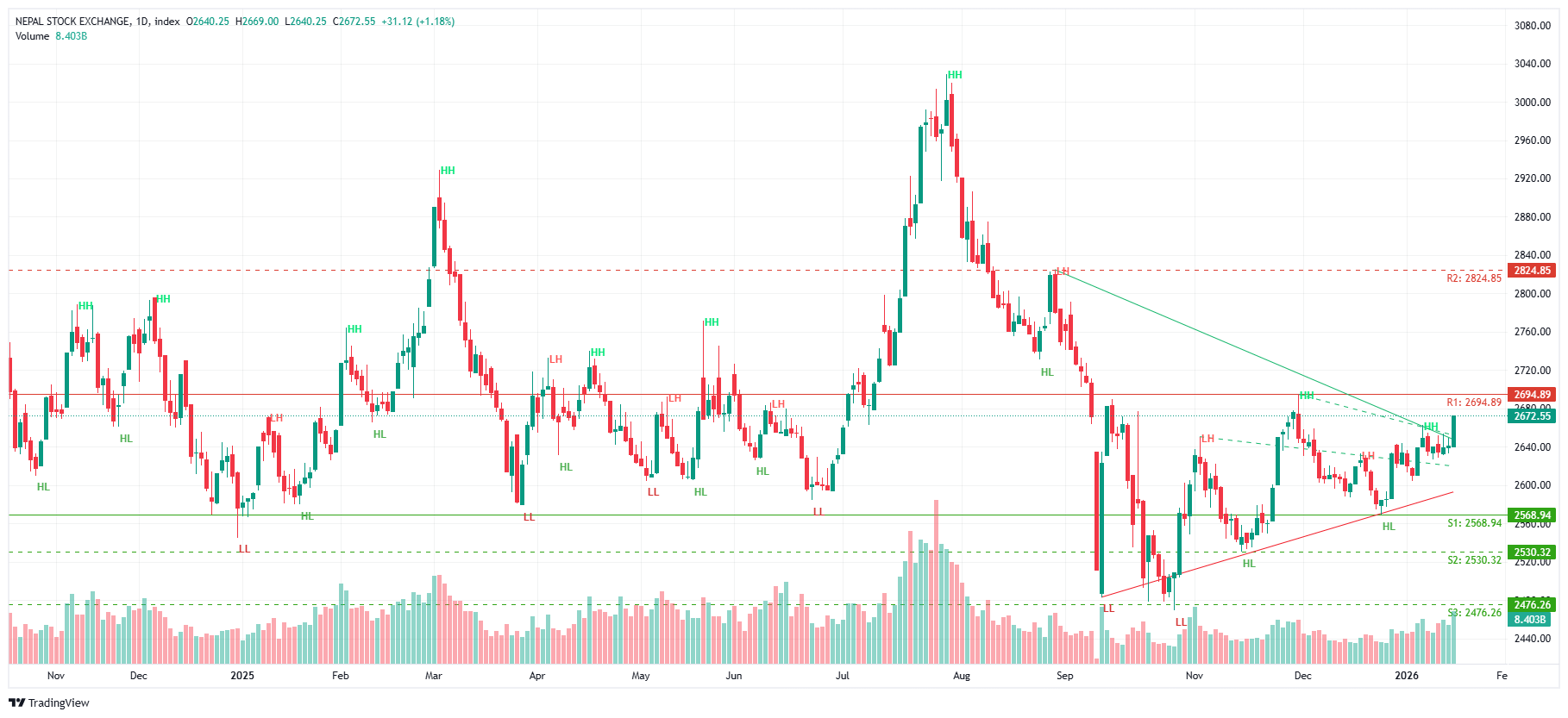
From a technical standpoint, the market has shown attempts to break out of a long-standing sideways trend. However, analysts caution that a key resistance level—formed by an ascending triangle pattern—has not yet been decisively breached. The index closed within this range, indicating that investors are still awaiting clearer confirmation.
After nearly 30 trading sessions, the market has once again approached its 200-day moving average. In the previous swing, the index failed to sustain above this level and faced sharp rejection near the 2,690-point zone. This history suggests that the current level remains technically sensitive.
Volatility indicators are beginning to shift. Bollinger Bands appear to be expanding, hinting at increased price movement in the coming sessions. The Relative Strength Index remains above the neutral zone, suggesting that bullish momentum has not fully dissipated, even though a decisive breakout is still pending.
Volume behavior has been particularly notable. Among the last 50 trading sessions, the most recent session recorded the highest turnover—often viewed as a constructive sign when the market is nearing a potential breakout. Rising volume near resistance levels typically signals accumulation rather than distribution.
The session itself opened with a gap down but quickly reversed course. The opening price marked the day’s low, while the index closed at the session high, forming a classic bullish marubozu candlestick. This pattern reflects strong intraday buying interest and reinforces short-term momentum.
Sector-wise, hydropower stocks accounted for a slightly smaller share of total turnover, while finance and development bank stocks saw a noticeable rise in activity. Broker data showed a balanced pattern, with five of the top ten brokers acting as net buyers and the remaining five as net sellers—indicating that the market is still in a consolidation phase rather than an overheated rally.
Late-session activity was also telling, with the index gaining nearly four points in the final minutes of trading. This suggests increasing participation toward the close. Overall, while the market appears to be positioned close to a breakout, analysts emphasize that confirmation above key resistance levels is essential before declaring the start of a sustained bullish phase.