By Sandeep Chaudhary
Political Stability and Market Sentiment – Fundamental Linkage
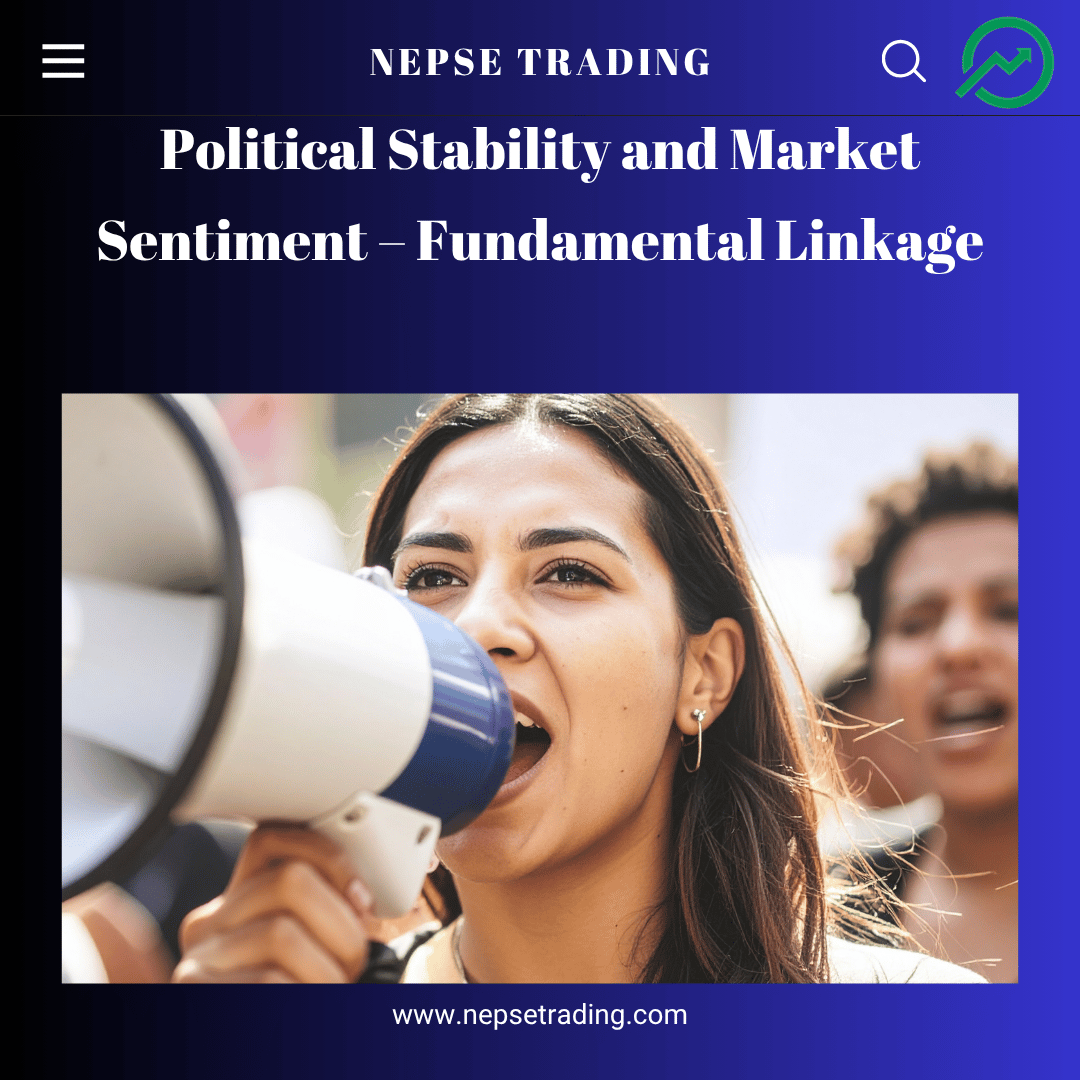
The relationship between political stability and market sentiment is one of the most powerful — yet often underestimated — fundamentals that drive the Nepal Stock Exchange (NEPSE). In any developing economy like Nepal, politics and policy decisions play a direct role in shaping investor confidence, foreign investment flow, fiscal policy, and long-term economic planning. When political leadership is stable and predictable, the stock market tends to perform well; when instability, protests, or frequent policy changes dominate, market sentiment quickly weakens.
Political stability means consistent governance, continuity of economic policy, and trust in the nation’s financial institutions. When investors believe the government can implement policies effectively — such as budget utilization, tax reforms, capital market development, and infrastructure spending — they gain confidence to invest long-term. This confidence is reflected in NEPSE’s rising trend, stable liquidity, and sectoral optimism. On the other hand, political uncertainty — such as government changes, strikes, policy reversals, or corruption scandals — triggers fear and capital outflow from the market. Investors avoid risk, reduce trading volume, and prefer holding cash or low-risk assets.
In Nepal’s history, every major political transition — from government dissolutions to election cycles — has had an immediate impact on NEPSE’s movement. The stock market typically reacts negatively to short-term disruptions but recovers once a new government forms and policy clarity returns. Stable governments tend to pass business-friendly budgets, promote private investment, and accelerate project implementation — all of which directly improve company earnings and share valuations.
The fundamental linkage lies in market psychology: stability builds confidence, while uncertainty creates fear. Political stability improves economic visibility, attracts Foreign Direct Investment (FDI), and allows consistent monetary-fiscal coordination between the Ministry of Finance and Nepal Rastra Bank (NRB). This harmony keeps interest rates stable, boosts liquidity, and strengthens NEPSE’s fundamentals.
According to Sandeep Kumar Chaudhary, Nepal’s leading Technical and Fundamental Analyst and founder of the NepseTrading Training Institute, “The market is not just driven by numbers but by confidence — and political stability is the foundation of that confidence.” With over 15 years of banking experience and having trained 10,000+ Nepali investors, he emphasizes that traders must watch political trends as carefully as financial indicators, because every major policy or instability reflects first in market sentiment and later in stock prices.