By Dipesh Ghimire
Road Expansion in Nepal: Rising Expectations, Persistent Barriers
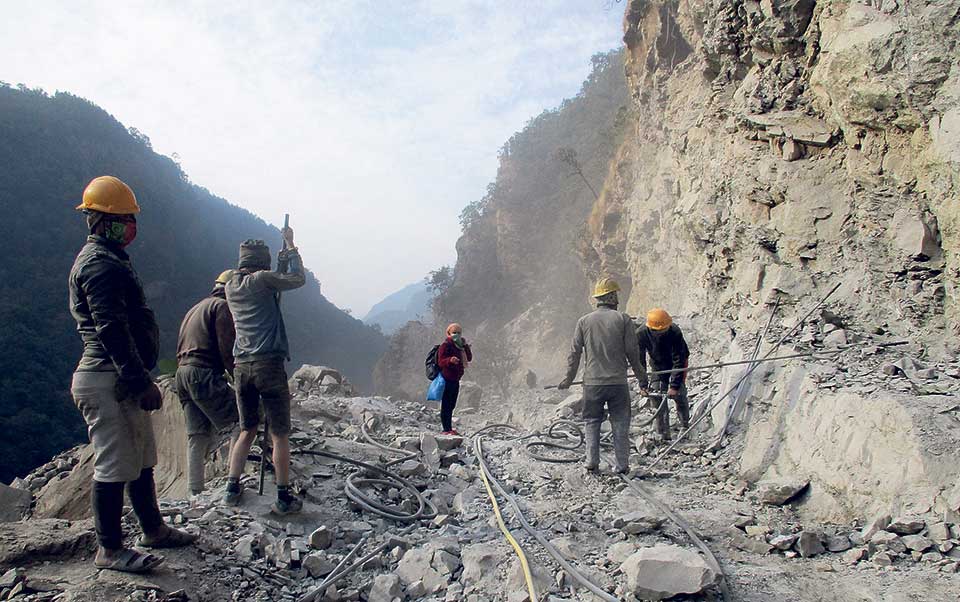
Nepal’s road transport system is broadly divided into two categories: the central road network and the local road network. The central road system has been managed by the Department of Roads under the Ministry of Physical Infrastructure and Transport since the 1960s, while local roads have been overseen by the Department of Local Infrastructure (DoLIDAR), and later by provincial and local governments. With the adoption of federalism, road responsibilities have been further divided among federal, provincial, and local levels, reshaping the country’s overall transport governance.
Under the current federal structure, national highways fall under the jurisdiction of the federal government. A total of 80 highways have been designated as national highways, with a combined length of about 14,913 kilometers. Provincial and local governments together manage nearly 90,000 kilometers of roads. Taken together, Nepal’s total road network now extends close to 100,000 kilometers, reflecting a significant expansion in physical connectivity across the country.
Four East–West Highways as the Backbone
The federal government has prioritized four major east–west highways to strengthen national connectivity. The oldest among them, the Mahendra Highway, stretches about 1,027 kilometers and is currently undergoing phased upgrading into a four-lane road with donor support. South of this highway lies the Postal Highway, a 975-kilometer corridor connecting districts of the Tarai. While most sections are complete, a few missing links—particularly those passing through national parks—remain unresolved, forcing policymakers to consider alternative alignments or integration with existing highways.
The Mid-Hill Highway, also known as the Pushpa Lal Highway, is another transformative project. Spanning roughly 1,776 kilometers, it connects hill districts that were once isolated from each other. Before its construction, travel between neighboring hill districts often required long detours through the Tarai. Although some bridges are still under construction, the highway is expected to become fully operational within the next two years, significantly reducing travel time and boosting economic activity in the hills.
Similarly, the Madan Bhandari Highway aims to connect Inner Madhes regions with high agricultural and industrial potential. By shortening travel routes and improving access, the highway has already reduced travel time in eastern Nepal and opened new opportunities for agriculture and small industries. Completion is expected within the next three to four years.
North–South Corridors and Regional Connectivity
To strengthen cross-border trade and strategic connectivity, Nepal is developing 11 north–south corridors linking India and China. Of these, three highways—Arniko Highway, Galchhi–Trishuli–Mailung–Syabrubesi, and Pokhara–Jomsom–Korala—are already operational. However, the Korala corridor has yet to function as a trade route due to the absence of customs infrastructure on the Nepali side, limiting its use to passenger traffic only.
By combining four east–west highways with north–south corridors, the federal government envisions a nationwide road grid. Provincial and local governments are simultaneously expanding feeder roads and rural links. If coordination among the three tiers of government improves, Nepal could develop a relatively efficient road transport network within the next decade.
Railways: A Long-Term but Costly Vision
Alongside roads, the government has also advanced plans for rail connectivity. A detailed project report for the East–West Railway has been prepared, but high construction costs have slowed implementation. Construction is currently underway on the Bardibas–Nijgadh section. Feasibility studies are also ongoing for north–south rail links connecting Kathmandu with India’s Raxaul and China’s Rasuwagadhi. Meanwhile, the Janakpur–Jaynagar railway, built with Indian assistance, is already operational, with extension works toward Bardibas in progress.
Road Conditions and Public Frustration
Public frustration over road conditions has grown, particularly in areas undergoing upgrading. Many highways are temporarily damaged due to widening and reconstruction works, causing travel delays. Officials argue that this inconvenience is inevitable during expansion. Major corridors such as the East–West Highway and the Narayanghat–Butwal section are being upgraded into multi-lane roads, while the Narayanghat–Muglin–Naubise corridor is being improved with separate lanes for heavy vehicles due to complex terrain.
At the basic level, Nepal has achieved near-universal road access. All 77 district headquarters are now connected to the road network. However, places like Humla and Dolpa still face year-round connectivity challenges due to the absence of permanent bridges. The Department of Roads aims to complete bridge construction in these areas within the current fiscal year.
Why Projects Get Delayed
Despite progress, delays remain a chronic issue. One major reason is the mismatch between contractors’ capacity and the volume of projects awarded to them. The government lacks a comprehensive database on contractors’ workloads, allowing some firms to take on more projects than they can handle. Weak coordination among government agencies, delays in utility relocation, shortages of construction materials, budget constraints in multi-year projects, and disruptions caused by floods, landslides, earthquakes, and COVID-19 have further slowed progress.
Payment delays have also stalled many projects. In some cases, politically driven project selection has resulted in insufficient budget allocation during implementation, leaving works incomplete. Local governments’ control over construction materials, combined with seasonal restrictions on riverbed extraction, has added another layer of complexity.
Towards Long-Term Solutions
Experts emphasize that projects should only be tendered after adequate preparation, including land acquisition and utility clearance. Budget assurance must come before launching new projects, and contractors should be assigned work strictly based on their verified capacity. Implementing a robust “bid capacity” system could prevent overloading contractors and improve accountability.
Clear policies on construction materials, timely payments, and greater decision-making authority at project sites are also seen as essential reforms. Equally important is local engagement. Early dialogue with communities about project benefits and impacts can reduce disputes and delays.
Ultimately, road expansion remains central to Nepal’s economic integration, market access, and job creation. While expectations are high, overcoming institutional weaknesses, coordination gaps, and policy inconsistencies will be crucial if road infrastructure is to deliver its promised economic and social returns.