Top
Latest
Popular
NEPSE Trading
Stock
Dipesh Ghimire
·

By Dipesh Ghimire

Demat Accounts Reach 6.55 Million, Mero Share Users Climb to 5.59 Million

Demat Accounts Reach 6.55 Million, Mero Share Users Climb to 5.59 Million

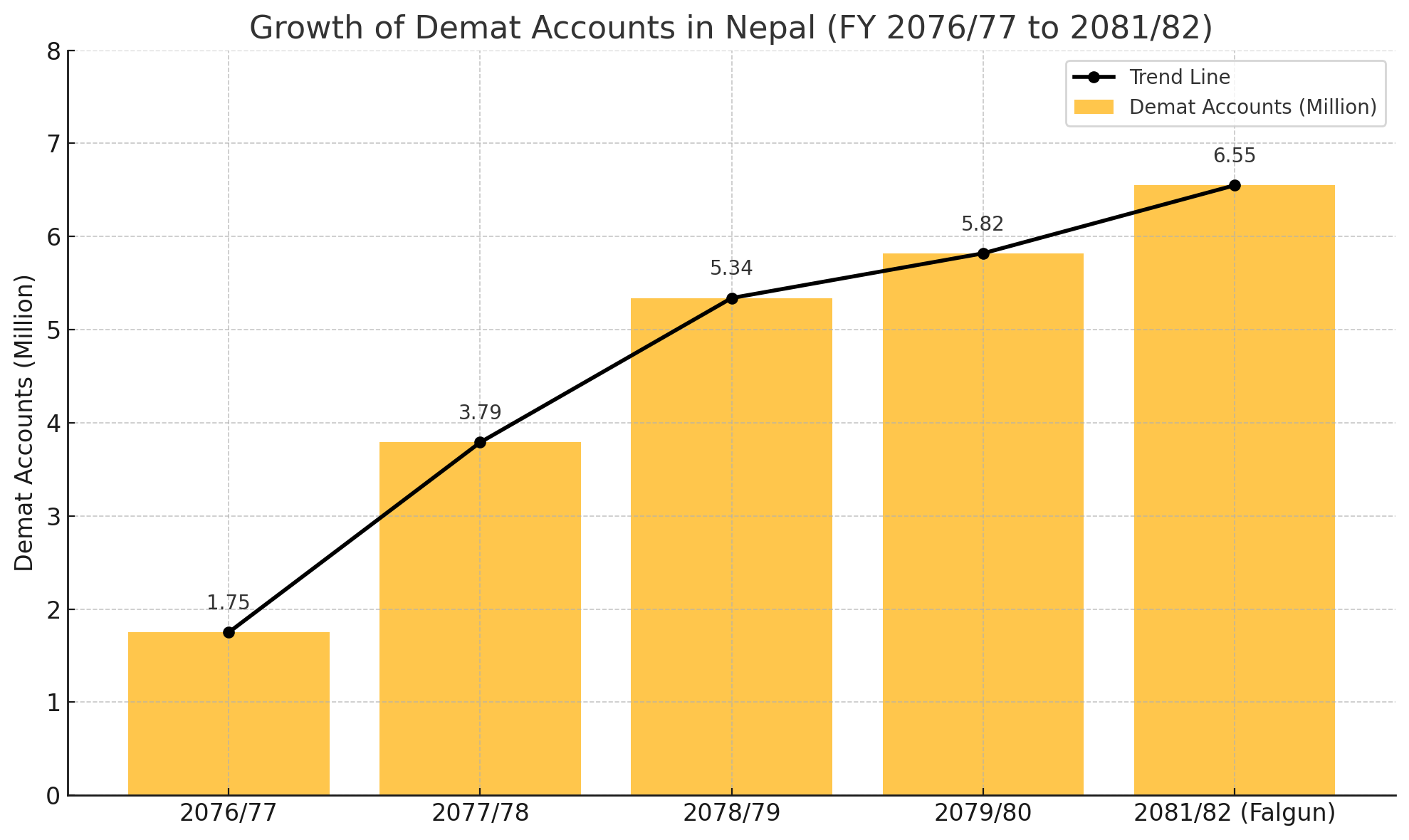
Kathmandu — As of the month of Falgun in the current fiscal year 2081/82 (mid-February 2025), the number of Demat (beneficiary) accounts in Nepal has reached 6.55 million, accounting for 22.44% of the country's total population. This is a notable increase from 5.82 million accounts recorded at the end of the previous fiscal year.

According to the Ministry of Finance, Demat account growth has been accelerating in recent years:

  • FY 2076/77: 1.75 million

  • FY 2077/78: 3.79 million

  • FY 2078/79: 5.34 million

  • FY 2079/80: 5.82 million

Surge in Mero Share Users

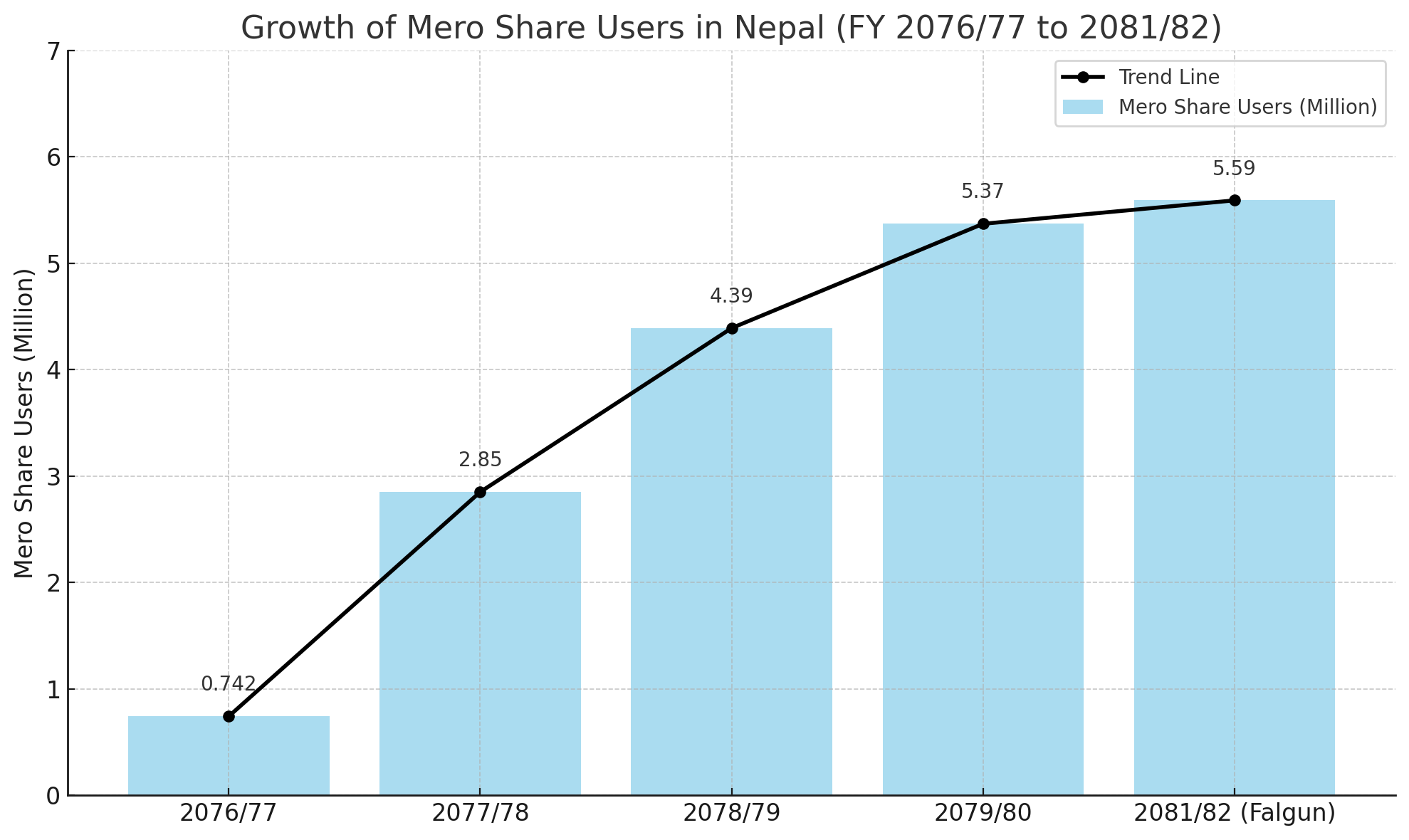
The number of Mero Share users — the online platform for share management — has also climbed to 5.59 million, about 19.15% of the population.

  • FY 2076/77: 742,000

  • FY 2077/78: 2.85 million

  • FY 2078/79: 4.39 million

  • FY 2079/80: 5.37 million

Dematerialized Securities and Online Access

  • The value of dematerialized securities with CDSC has reached NPR 128.65 billion.

  • The number of registered companies for dematerialization: 254

  • Depository participants (DPs): 119

  • Investors with online trading login credentials: 2.55 million

Capital Mobilization Drops by 26.28%

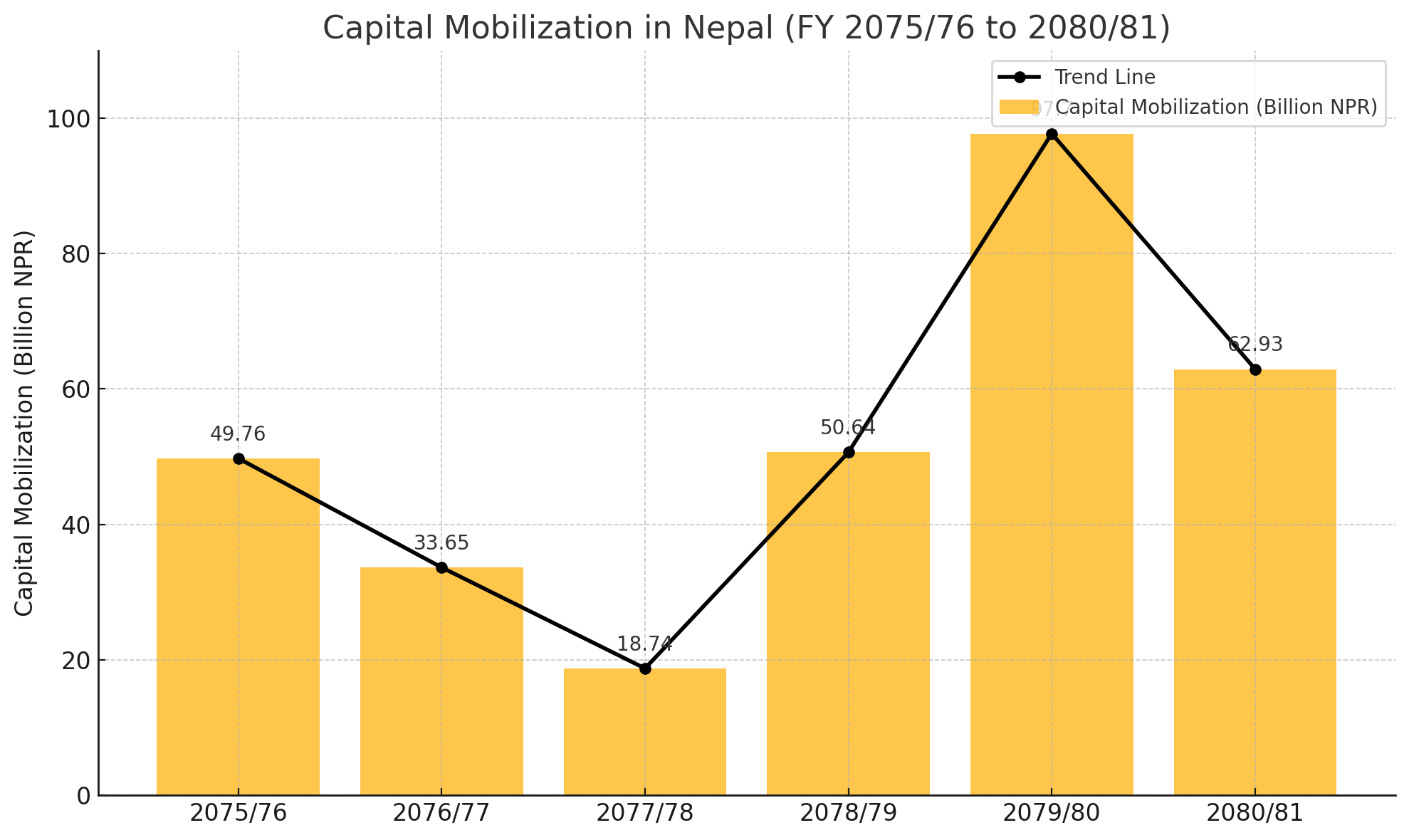
As of Falgun, the primary market has mobilized NPR 24.92 billion, which is 26.28% lower than NPR 33.80 billion raised during the same period last fiscal year.

Past Capital Mobilization by Fiscal Year:

  • FY 2080/81: NPR 62.93 billion

  • FY 2079/80: NPR 97.70 billion

  • FY 2078/79: NPR 50.64 billion

  • FY 2077/78: NPR 18.74 billion

  • FY 2076/77: NPR 33.65 billion

  • FY 2075/76: NPR 49.76 billion

Breakdown by Instrument in 2081/82:

  • Ordinary Shares: NPR 1.02 billion

  • Rights Shares: NPR 9.30 billion

  • Additional Shares: NPR 110 million

  • Debentures: NPR 3.30 billion

  • Mutual Funds: NPR 11.20 billion

Secondary Market Booms

By Falgun, secondary market turnover has hit NPR 1.455 trillion, a massive increase from NPR 415.78 billion during the same period last year.

  • Average daily turnover (147 trading days): NPR 9.90 billion

  • Turnover volume increased by 159.2%

  • Number of trades increased by 58.7%

Market Capitalization Jumps 37.1%

  • As of Falgun 2080: NPR 33.14 trillion

  • As of Falgun 2081: NPR 45.43 trillion

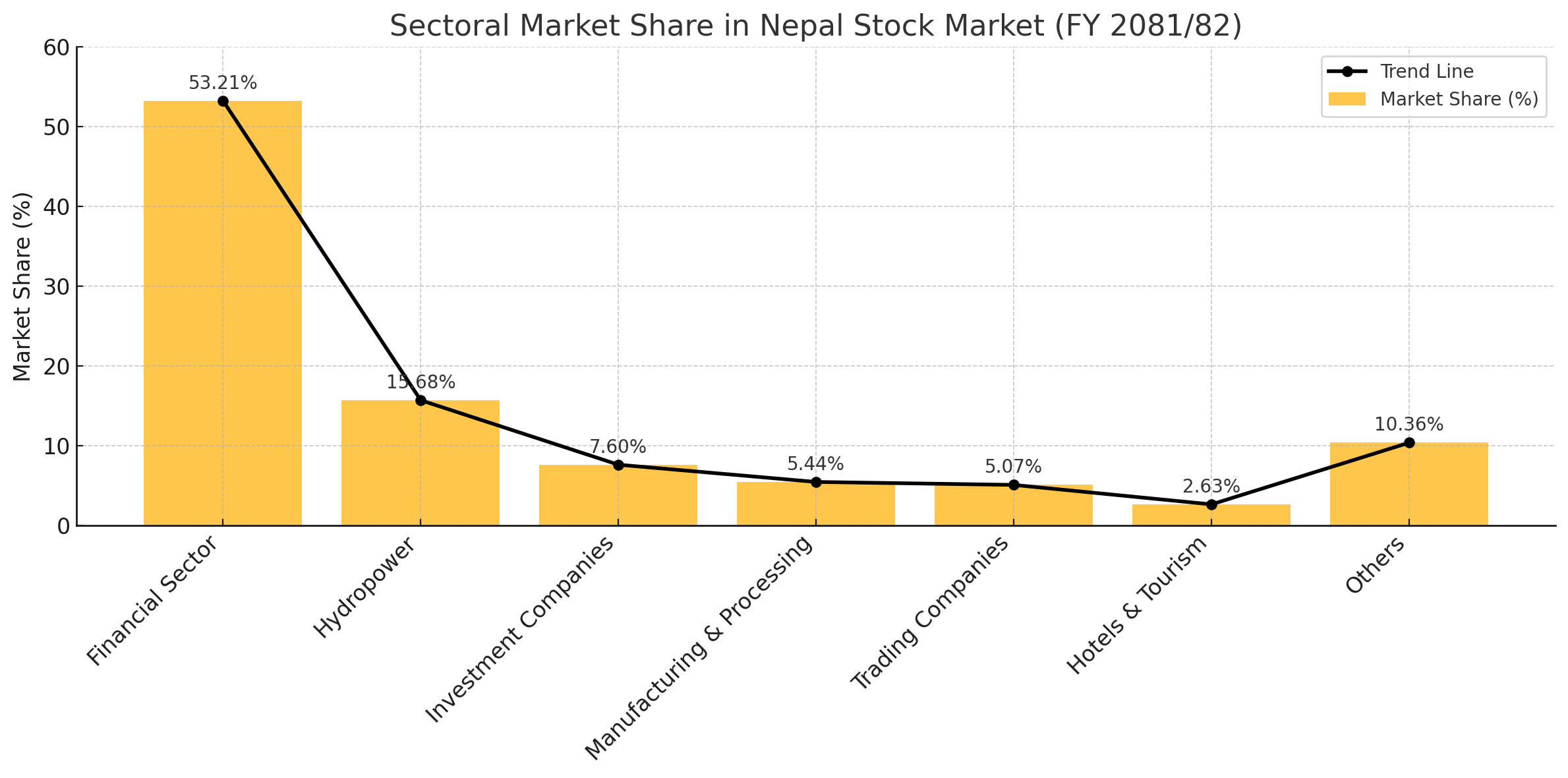
Sectoral Market Share:

  • Financial Sector: 53.21%

  • Hydropower: 15.68%

  • Investment Companies: 7.60%

  • Manufacturing & Processing: 5.44%

  • Trading Companies: 5.07%

  • Hotels & Tourism: 2.63%

  • Others: 10.36%

Listed Companies and Securities

  • Listed companies on NEPSE: 268 (including Guardian Micro Life Insurance as the latest addition)

  • Paid-up capital of listed shares: NPR 857.50 billion (up from NPR 810.41 billion last year)

Securities Listed So Far in FY 2081/82:

  • Primary shares: 7.5 million units

  • Mutual fund units: 250 million

  • Rights shares: 56.2 million

  • Bonus shares: 143.9 million

  • Additional shares: 50.6 million

  • Institutional bonds: 300,000 units

Nepal's capital market is experiencing rapid digitalization and user growth. While online access, demat account usage, and trading volumes are soaring, the primary market's capital mobilization has declined — signaling a need for regulatory reforms and enhanced investor confidence. Still, the sharp rise in secondary market activity and market capitalization indicates strong momentum in retail and institutional trading behavior.

Related Blogs

Global IME Laghubitta Faces Profit Pressure Despite Strong Income Growth
Top

3 min read

Global IME Laghubitta Faces Profit Pressure Despite Strong Income Growth

Global IME Laghubitta Faces Profit Pressure Despite Strong Income Growth Global IME Laghubitta Bittiya Sanstha Limited has released its unaudited financial report for the second quarter of the current fiscal year, showing a decline in net profit despite significant growth in core income. The report reflects the growing challenges faced by microfinance institutions amid weakening loan quality and rising financial risks. During the review period, the company earned a net profit of NPR 105.9 million. In the same period last year, it had recorded a profit of NPR 118.3 million. This represents a decline of around 10.51 percent. Analysts say the fall in profit indicates increasing pressure on microfinance companies as repayment capacity weakens in many rural and semi-urban areas. Although profit declined, the company’s net interest income showed strong improvement. By mid-Poush, net interest income reached NPR 487.6 million, up from NPR 350.7 million in the previous year. This nearly 39 percent growth suggests that the company has expanded its lending activities and strengthened its interest collection mechanism. Similarly, total operating income rose to NPR 521.8 million from NPR 392.1 million last year, recording a growth of about 33 percent. The increase reflects higher loan disbursement, improved service coverage, and greater outreach among low-income borrowers. Experts interpret this as a sign that demand for microfinance services remains strong despite economic uncertainty.

Dipesh Ghimire

·

8 Feb, 2026

High-Level Panel Urges Capital Expansion and Structural Reform for Nepal Stock Exchange
Top

4 min read

High-Level Panel Urges Capital Expansion and Structural Reform for Nepal Stock Exchange

High-Level Panel Urges Capital Expansion and Structural Reform for Nepal Stock Exchange A high-level committee formed to restructure the Nepal Stock Exchange (NEPSE) has concluded that increasing the exchange’s paid-up capital is essential for its long-term sustainability and competitiveness. The 126-page report, prepared under the coordination of former Nepal Accounting Board chairperson Prakash Jung Thapa, was made public by the Ministry of Finance, Nepal on Tuesday. The report states that although the Securities Market Operation Regulation, 2007 requires a minimum paid-up capital of NPR 3 billion for a secondary market operator, NEPSE is currently operating with only NPR 1 billion. According to the committee, this gap has limited the exchange’s ability to modernize its services and compete with regional and international markets. The committee has warned that without sufficient capital, NEPSE cannot make the necessary investments in technology, human resources, infrastructure, research, and service expansion. To address this, it has recommended issuing bonus shares to immediately raise paid-up capital to NPR 3 billion. If additional funding is required in the future, the report suggests mobilizing resources through rights shares or fresh public offerings. Analysts believe this recommendation reflects growing concern over NEPSE’s weakening institutional capacity. In recent years, the exchange has struggled to keep pace with technological change, while neighboring markets have invested heavily in automation, surveillance, and data systems. As a result, Nepal’s capital market has remained relatively small and less attractive to foreign investors. The report has also highlighted weaknesses in NEPSE’s ownership and governance structure. At present, the Government of Nepal holds 58.66 percent ownership, while the remaining shares are held by public and financial institutions. The committee argues that this structure has reinforced bureaucratic control and limited managerial flexibility. To address this, the panel has proposed partial divestment and the introduction of strategic partners. However, it has ruled out full privatization, warning that complete government withdrawal could weaken small investors’ confidence, increase the risk of monopoly, and undermine market self-regulation. Instead, it recommends maintaining partial state ownership while gradually reducing government stakes. Under the proposed model, strategic partners may be allowed to hold between 15 and 25 percent ownership, with a mandatory lock-in period of at least ten years. The report states that such partners should be selected from leading global stock exchanges with at least 20 years of experience and membership in the World Federation of Exchanges (WFE).

Dipesh Ghimire

·

4 Feb, 2026

Nepal Strengthens Cyber Defenses as Digital Banking Risks Continue to Rise
Top

3 min read

Nepal Strengthens Cyber Defenses as Digital Banking Risks Continue to Rise

Nepal Strengthens Cyber Defenses as Digital Banking Risks Continue to Rise As Nepal’s digital financial ecosystem expands rapidly, concerns over cyber threats and data security are becoming increasingly prominent. Against this backdrop, the Nepal Bankers Association (NBA), in collaboration with Visa, organized a national-level workshop in Kathmandu aimed at strengthening the country’s cyber resilience. The event, titled “Strengthening Cybersecurity Resilience in Nepal,” was held on Magh 14 and brought together key stakeholders from across the financial and security sectors. The workshop was organized at a time when digital payments, mobile banking, and online transactions are growing at an unprecedented pace. While these developments have improved financial access and efficiency, they have also increased Nepal’s exposure to cyber fraud, data breaches, and digital crimes. Organizers said the program was designed to help institutions better understand emerging threats and improve their preparedness. High-level representatives from government agencies, regulatory bodies, security institutions, banks, financial companies, and international development partners participated in the event. According to the organizers, this broad participation reflected a shared recognition that cybersecurity is no longer a technical issue alone but a national priority linked to economic stability and public trust. The inaugural session was attended by officials from the Ministry of Communication and Information Technology, the cyber security directorate of the Nepal Army, Nepal Rastra Bank, and the International Finance Corporation (IFC). Their presence highlighted the growing importance of inter-agency coordination in protecting Nepal’s digital economy.

Dipesh Ghimire

·

4 Feb, 2026