By Dipesh Ghimire
Nepal’s Trade Structure Reveals Consumption-Driven Economy as Terms of Trade Slightly Improve
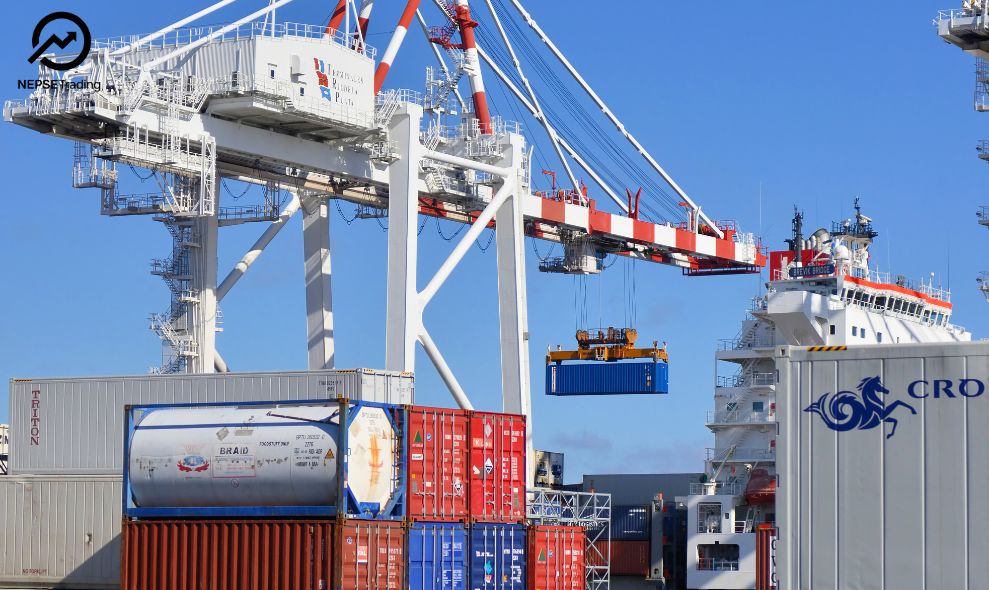
Kathmandu — Nepal’s external sector continues to highlight deep structural characteristics, with the composition of exports and imports clearly indicating a consumption-driven economy and limited industrial depth. According to data up to Falgun of fiscal year 2082/83, the structure of foreign trade shows a significant dominance of final consumption goods in exports, while imports remain heavily concentrated in intermediate and capital goods.
Based on broad economic classification, 69.1 percent of Nepal’s total exports during the review period consisted of final consumption goods, while intermediate goods accounted for 30.0 percent and capital goods for a negligible 0.9 percent. Compared to the previous year, the share of consumption goods in exports has increased from 64.1 percent, while the share of intermediate goods has declined from 35.2 percent. This shift suggests that Nepal’s export base is becoming increasingly concentrated in finished or semi-finished goods intended for direct consumption, rather than raw materials or industrial inputs. While this may reflect short-term export gains, it also signals limited progress in building a strong industrial supply chain capable of exporting higher-value intermediate or capital goods.
On the import side, the structure further reinforces Nepal’s dependence on foreign economies for production and development needs. Final consumption goods account for 37.1 percent of total imports, while intermediate goods dominate with 53.6 percent, and capital goods make up 9.3 percent. Compared to the previous year, the share of intermediate and capital goods has increased, while the share of consumption goods has declined. This trend indicates that Nepal is importing more raw materials and machinery, which could be a positive sign for industrial activity and infrastructure development. However, the relatively modest share of capital goods suggests that large-scale industrial expansion remains limited.
The contrast between export and import structures highlights a fundamental imbalance: Nepal exports primarily consumption-oriented goods but imports production inputs and capital-intensive goods. This asymmetry reflects the country’s reliance on external economies not only for consumer demand but also for sustaining domestic production systems.
Price indicators in the external sector show a slight improvement in trade conditions. The unit value index of exports increased by 2.5 percent year-on-year, while the import price index rose by 1.9 percent. As a result, the terms of trade improved by 0.5 percent during the review period. This means that the prices of Nepal’s exports have increased at a slightly higher rate than the prices of imports, allowing the country to gain marginally better value in international trade.
Although the improvement in terms of trade is modest, it provides some relief to the external sector by slightly enhancing export earnings relative to import costs. However, this gain is not substantial enough to offset the structural trade deficit and dependency on imports.
Overall, Nepal’s foreign trade structure reflects a transitional economy that is gradually increasing industrial input imports but still lacks a strong export base in high-value goods. While improvements in price competitiveness are visible, long-term sustainability will depend on strengthening domestic production, diversifying export products, and increasing the share of capital goods both in production and export capacity.