By Dipesh Ghimire
NEPSE at a Crossroads: Rebound Signals Emerge, but Market Direction Remains Fragile
Kathmandu. After two consecutive sessions of sharp decline that wiped out nearly 119 points, the Nepal Stock Exchange (NEPSE) showed signs of recovery on Tuesday, gaining 19.70 points to close at 2,851.09. While this rebound has offered temporary relief to investors, underlying indicators suggest that the market is still navigating a fragile phase, where confidence has not fully returned and direction remains uncertain.
The recent uptick came amid a crucial meeting between a group of active investors and Finance Minister Swarnim Wagle, which appears to have played a key role in stabilizing market sentiment. Investors had raised concerns over unexpected volatility, policy ambiguity, and psychological pressure. In response, the minister assured that no adverse policies targeting the stock market would be introduced and emphasized the government’s commitment to capital market development. This assurance has eased short-term fears, but market participants are still waiting for concrete policy actions before regaining full confidence.
Despite the index moving upward, trading turnover declined noticeably—from over Rs 12.96 billion in the previous session to around Rs 11.11 billion. This divergence between price and volume is often interpreted as a sign of weak conviction. In essence, while prices have rebounded, the lack of strong participation—especially from institutional or large investors—suggests that the rally may not yet be sustainable. The market, at this stage, appears to be driven more by short-term sentiment than by strong accumulation.
From a technical perspective, the index has reacted positively from a historically significant support zone around 2,785–2,790. This level aligns with a key Fibonacci retracement and has repeatedly acted as a demand zone in past cycles. The fact that the market respected this level indicates that buyers are still active at lower ranges. However, other indicators present a mixed picture. The Relative Strength Index (RSI), which had previously entered overbought territory, has now cooled down toward neutral levels, suggesting that the market is no longer overheated. This could provide room for short-term stabilization.
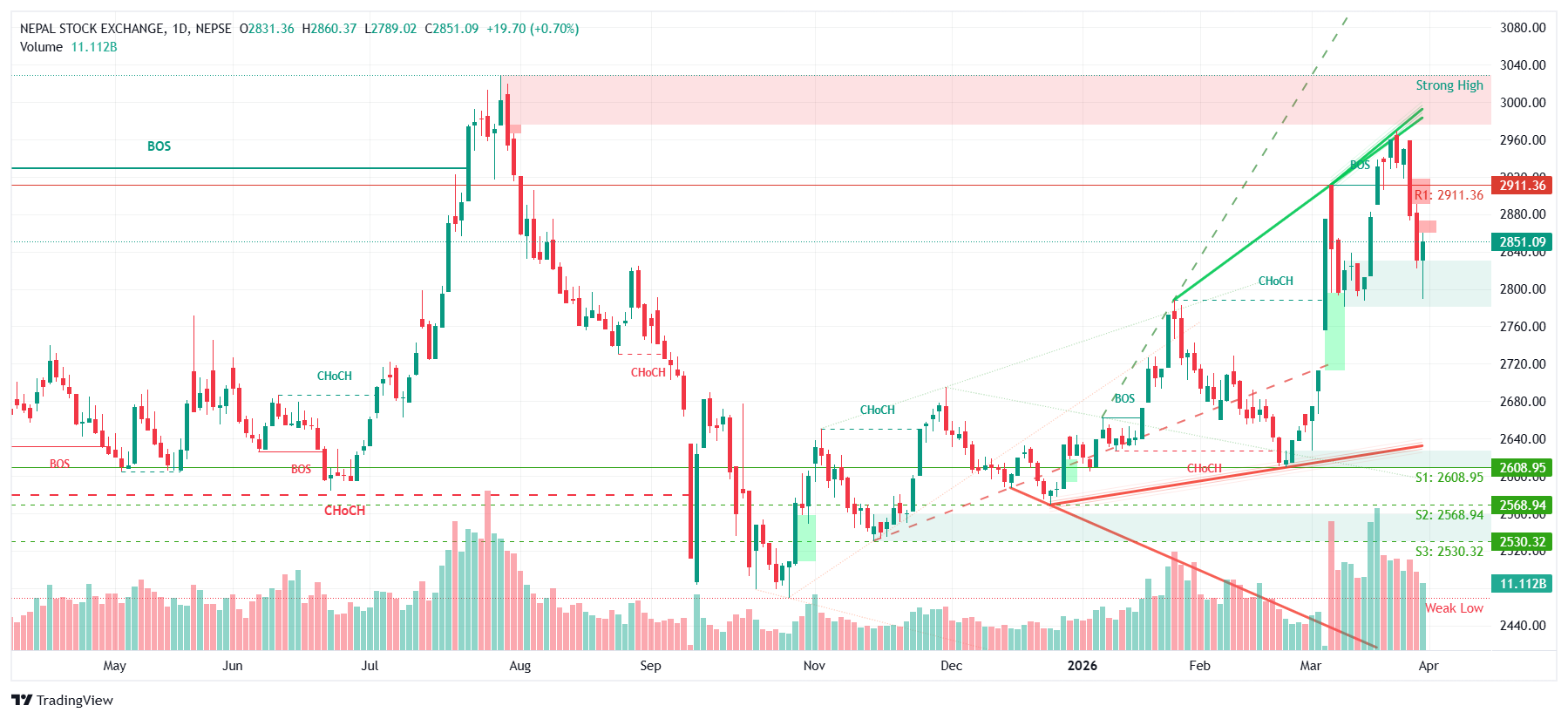
On the other hand, the Moving Average Convergence Divergence (MACD) has recently formed a bearish crossover after maintaining a bullish trend for several sessions. This is a critical signal, often indicating that downward pressure has not fully dissipated. Additionally, the absence of a Higher High (HH) formation in recent candlesticks reinforces the notion that the market has not yet transitioned into a confirmed uptrend. Tuesday’s candle, therefore, is better interpreted as a rebound reaction rather than a trend reversal.
Sectoral dynamics further highlight the market’s delicate balance. Tuesday’s recovery was largely supported by banking and hydropower stocks, which played a stabilizing role after the recent sell-off. If these sectors continue to attract buying interest, they could provide short-term support to the index. However, any profit booking in these segments could quickly reverse the gains, given the lack of broader market strength.
Broker-wise data also points toward continued distribution. Among the top 10 brokers, a majority were net sellers, indicating that large players are still offloading positions rather than aggressively accumulating. This behavior typically reflects caution among institutional participants and suggests that “smart money” is not yet fully convinced of a sustained upward move.
Adding another layer of complexity, regulatory developments have introduced both optimism and concern. The ongoing investigation into the use of billions of rupees linked to Himalayan Reinsurance has raised questions about financial transparency and governance. While such actions may strengthen long-term credibility and regulatory discipline, they can also trigger short-term uncertainty, particularly in the insurance sector. As a result, volatility in related stocks is expected to remain elevated.
Political developments have also played a significant role in shaping investor sentiment. The recent arrest of high-profile political figures has heightened uncertainty in the broader environment, prompting investors to adopt a cautious stance. Moreover, the government’s 100-point governance reform plan, which lacks clear and immediate capital market measures, has added to the ambiguity, leaving investors searching for clearer direction.
Looking ahead, the market’s next move will largely depend on three critical factors: whether the index can break above its recent high and sustain gains, whether trading volume increases to support the upward move, and whether institutional investors return with stronger participation. If these conditions are met, the current rebound could evolve into a more meaningful recovery. Otherwise, the market risks slipping back into a corrective phase, potentially retesting lower support levels.
In conclusion, while Tuesday’s rebound has injected a degree of optimism into the market, it remains a tentative recovery rather than a confirmed turnaround. The NEPSE is currently in a transitional phase, where signals are mixed and conviction is limited. For investors, this is less a moment for aggressive positioning and more a period for careful observation, where patience and disciplined decision-making will be crucial in navigating the days ahead.