By Dipesh Ghimire
NEPSE Faces Selling Pressure Amid Black Money Concerns; Market Enters a Critical Transition Phase

Kathmandu — The Nepal Stock Exchange (NEPSE) witnessed a sharp decline in the previous trading session, falling by 47 points to close at 2,831. Despite an optimistic start that pushed the index close to the 2,890 level, the market failed to sustain higher levels, retreating significantly toward the closing hours. This late-session weakness reflects a shift in investor sentiment, with caution beginning to dominate short-term market behavior.
Market observers attribute the recent pressure partly to growing discussions around regulatory tightening under the leadership of Balen Shah. The government’s move to reopen old financial and administrative files involving high-profile individuals has sparked concerns over financial transparency and accountability. This has led to speculation that funds with questionable origins, previously active in the stock market, may begin to exit or reposition, creating a temporary imbalance between supply and demand.
Analysts suggest that such fears, whether fully substantiated or not, have already triggered a wave of cautious selling, particularly among large investors. The possibility of capital being withdrawn or reallocated has increased selling pressure, contributing to the recent downturn. In the short term, this dynamic may reduce liquidity and intensify volatility, especially if significant volumes continue to enter the market on the sell side.
However, from a broader perspective, this phase is also being interpreted as part of a market cleansing process. Greater regulatory enforcement and transparency could enhance long-term credibility and institutional strength. While the immediate impact may be unsettling, the structural benefits could position the market for healthier and more sustainable growth in the future.
At the same time, macroeconomic conditions remain supportive. The policy stance of Nepal Rastra Bank appears accommodative, with interest rates hovering near historic lows. Limited alternative investment avenues continue to channel funds toward equities. Additionally, the government’s commitment to implementing recommendations from the high-level economic reform task force, along with the operationalization of margin trading through brokers, signals potential for increased market participation and capital inflows.
From a technical standpoint, the latest daily candle has formed a bearish rejection pattern with a long upper wick, indicating strong resistance at higher levels. The market’s inability to hold gains near the 2,890–2,900 zone suggests that sellers are actively defending this region. This is often interpreted as a sign of profit booking after a recent upward move.
Structurally, the presence of a Break of Structure (BOS) in recent sessions confirms that the market remains bullish in the medium term. However, emerging Change of Character (CHoCH) signals on lower timeframes indicate weakening momentum in the short term. This divergence suggests that while the broader trend remains intact, the market may undergo consolidation or correction in the near term.
Key resistance is observed in the 2,910–2,960 range, a zone that has repeatedly rejected upward attempts. On the downside, the 2,800 level stands as a crucial psychological support. A sustained hold above this level could allow the market to stabilize and attempt another upward move. Conversely, a breakdown below this zone may open the path toward deeper support levels around 2,608 and beyond.
Volume patterns further reinforce the cautious outlook. The increase in trading volume during the decline indicates a possible distribution phase, where stronger hands may be offloading positions. While this does not necessarily signal a trend reversal, it often precedes a period of consolidation.
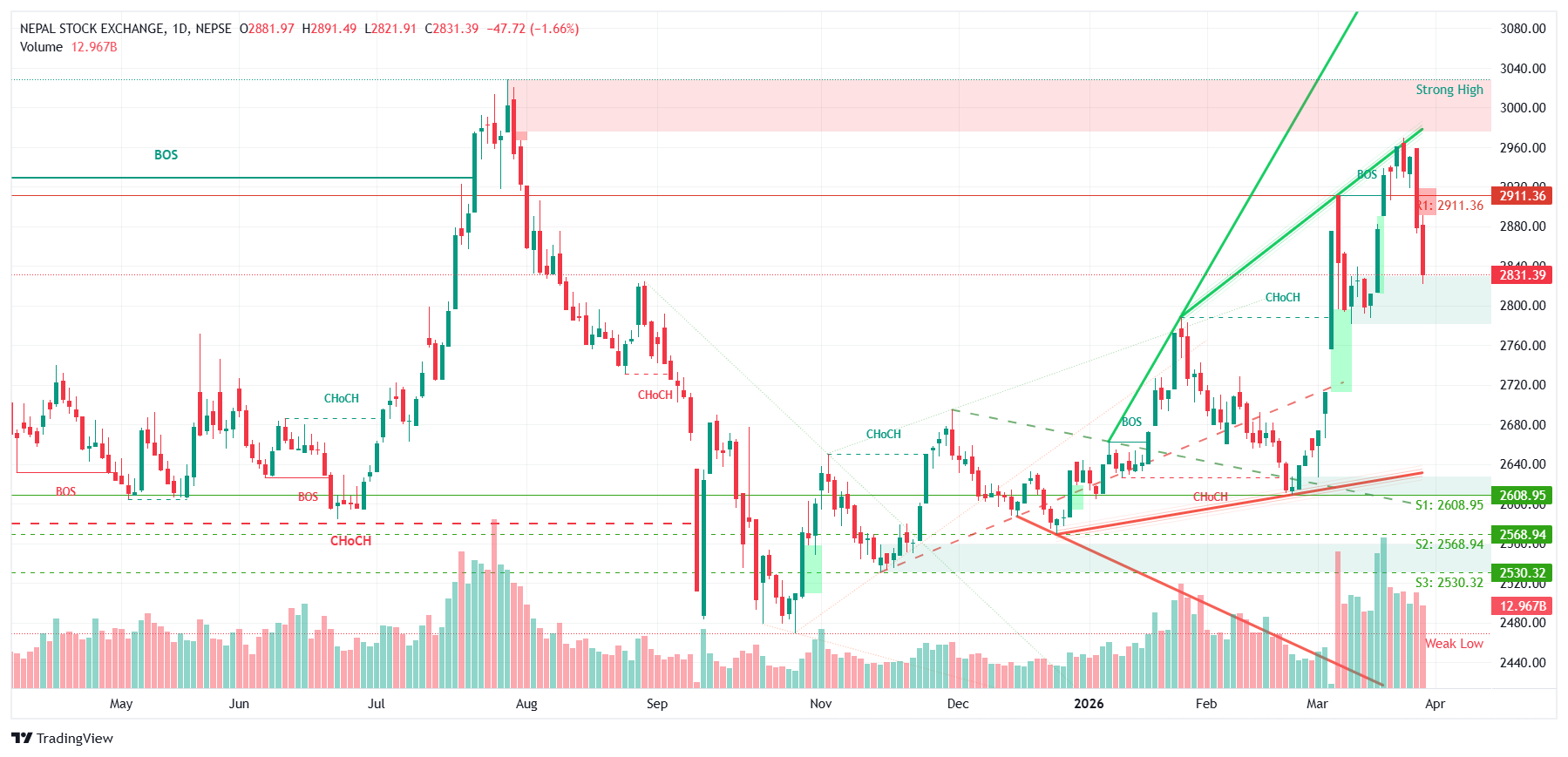
In conclusion, the NEPSE appears to be navigating a delicate balance between short-term pressure and long-term opportunity. The interplay between regulatory developments, investor psychology, and technical signals will likely determine the market’s next direction. For the upcoming session, all eyes remain on the 2,800 support zone—its behavior could define whether the market regains strength or extends its corrective phase.