#NepalEconomy #CPI #WPI #Infla
·

By Sandeep Chaudhary

CPI vs WPI: Which Reflects Nepal’s Inflation Better?
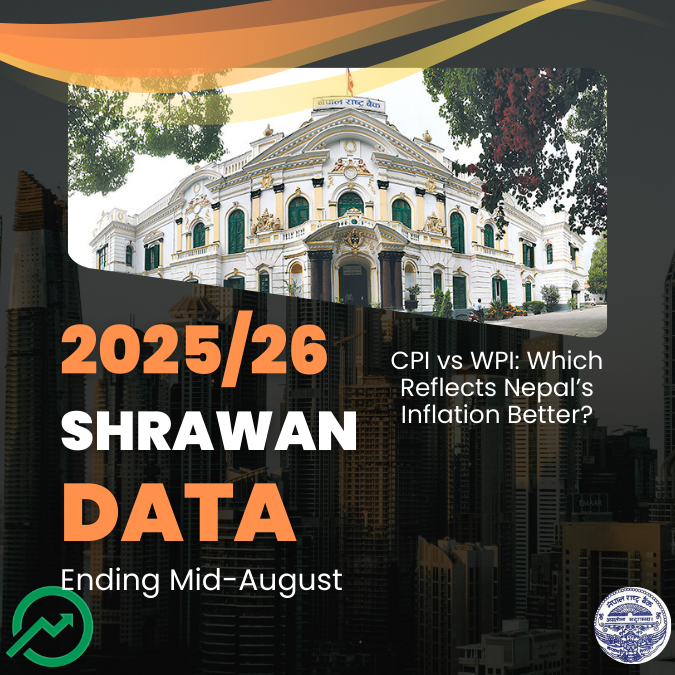
CPI vs WPI: Which Reflects Nepal’s Inflation Better?

Nepal tracks inflation through both the Consumer Price Index (CPI) and the Wholesale Price Index (WPI), but each provides a different lens. The CPI measures changes in the prices of goods and services consumed by households, while the WPI tracks prices at the wholesale or producer level. Recent data from FY 2082/83 shows CPI inflation cooling sharply to 1.68% in mid-August 2025, while WPI stood slightly higher at 2.37%. This divergence raises the question: which index better captures the real inflation experience in Nepal?

The CPI is often seen as the more relevant measure for the public because it directly reflects household expenses. It captures the day-to-day cost of living, including food, housing, education, health, and transport. For example, despite overall CPI easing, non-food inflation remains sticky at 3.95%, signaling rising costs in rent, healthcare, and utilities. On the other hand, food CPI has fallen to -2.28%, creating short-term consumer relief. These shifts immediately affect household purchasing power, making CPI the go-to measure for policymakers concerned with welfare and demand.

The WPI, however, acts as an early warning signal for future inflation. Since it reflects wholesale and producer-level prices, movements in WPI often precede changes in CPI. For instance, the drop in WPI from double-digit highs in FY 2021/22 (12.74%) to just 2.37% by mid-August 2082/83 has helped anchor consumer prices, leading to today’s low CPI. Still, very low WPI may also indicate weak demand and sluggish industrial activity, which could have broader implications for growth and employment.

In Nepal’s current context, CPI better reflects the lived reality of inflation, especially in terms of consumer welfare and household pressure. But WPI is indispensable for understanding cost structures in production and predicting future inflation trends. Policymakers and investors need both: CPI to track how inflation affects households, and WPI to anticipate potential inflationary pressures or risks of demand weakness in the economy.
Related Blogs

ABC Securities Investor Pro Meet 2082 Concludes Successfully in Birgunj
Top

3 min read

ABC Securities Investor Pro Meet 2082 Concludes Successfully in Birgunj

ABC Securities Investor Pro Meet 2082 Concludes Successfully in Birgunj The ABC Securities Investor Pro Meet 2082, organized under the financial literacy campaign of ABC Securities, was successfully held in Birgunj with strong participation from investors, market experts, and business leaders. The one-day program included share market training, panel discussions, and interactive sessions aimed at improving investors’ understanding of Nepal’s capital market. According to the organizers, the main objective of the event was to strengthen investors’ knowledge, skills, and confidence so that they can make informed and responsible investment decisions. The program reflected the growing demand for structured and practical market education among Nepalese investors. In recent years, participation in the stock market has increased rapidly, especially among young and first-time investors. However, many of them still lack proper understanding of market risks, technical analysis, and long-term investment planning. By organizing such events, ABC Securities is attempting to bridge this knowledge gap and promote disciplined investment behavior. The ABC Securities Investor Pro Meet 2082, organized under the financial literacy campaign of ABC Securities, was successfully held in Birgunj with strong participation from investors, market experts, and business leaders. The one-day program included share market training, panel discussions, and interactive sessions aimed at improving investors’ understanding of Nepal’s capital market. According to the organizers, the main objective of the event was to strengthen investors’ knowledge, skills, and confidence so that they can make informed and responsible investment decisions. The program reflected the growing demand for structured and practical market education among Nepalese investors. In recent years, participation in the stock market has increased rapidly, especially among young and first-time investors. However, many of them still lack proper understanding of market risks, technical analysis, and long-term investment planning. By organizing such events, ABC Securities is attempting to bridge this knowledge gap and promote disciplined investment behavior.

Dipesh Ghimire

·

23 Feb, 2026