By Dipesh Ghimire
NEPSE at Crossroads: Which Direction Will the Market Take Today?
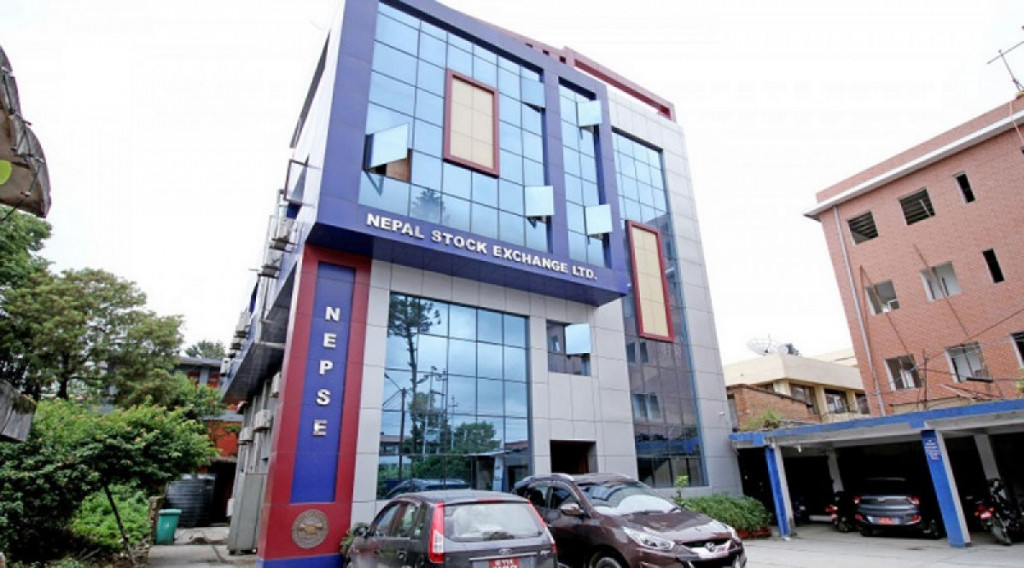
KATHMANDU — After Monday's impressive single-day surge of 83 points that had briefly rekindled investor optimism, Nepal's stock market pulled back on Tuesday, closing at 2,757.40 points — down just 2.61 points. While the decline itself appears modest on paper, the story the chart tells is far more unsettling. The index climbed as high as 2,794 during the session, only to be dragged back down by selling pressure before the close. In technical analysis, this pattern is known as a "bearish rejection" — and it is rarely a signal to be taken lightly. As the market prepares to open on Wednesday, investors find themselves caught between cautious hope and quiet anxiety.
Tuesday's trading volume painted an equally uninspiring picture. Monday had recorded a remarkable Rs. 10.92 billion in turnover — but by Tuesday, that figure had nearly halved, shrinking to Rs. 6.73 billion. A total of 345 companies saw their shares change hands across 81,582 transactions, with 17.4 million units traded. When a market's volume collapses so sharply the very next day after a strong rally, it raises a legitimate question: was Monday's surge driven by genuine buying conviction, or was it merely a short-lived technical bounce?
Amid the broader gloom, the hydropower sector managed to inject some energy into Tuesday's session. Six stocks — Bhujung Hydropower, Super Khudi Hydropower, Shwetganga Hydropower and Construction, Ridge Line Energy, Suryakund Hydro Electric, and Hotel Forest Inn — hit their positive circuit levels. Trishuli Jal Vidyut Company's share price climbed more than 8.5 percent, standing out as one of the session's brightest performers. On the other end of the spectrum, NIBL Growth Fund's unit value fell 7.08 percent — the steepest single-day decline among actively traded instruments. In terms of turnover value, Ngadi Group Power led the day with Rs. 242.26 million worth of shares traded, followed by Reliance Spinning Mills and Aankhuwakhola Jal Vidyut Company.
The sub-index performance reflected a market struggling to find direction. Of 13 sub-groups, only four managed to close in the green while nine ended in the red. The Hotels and Tourism sub-index led the gainers, rising 1.08 percent, while the Trading sub-index suffered the steepest fall at 1.88 percent. Banking, Hydropower, and Other sub-indices recorded marginal gains, but not enough to offset the broader weakness.
Beyond the numbers, two significant off-market developments continued to weigh on investor sentiment. The Securities Board of Nepal (SEBON) reportedly imposed a three-month trading suspension on Bhrikuti Securities, operating as Broker No. 55 — but the official circular never reached either NEPSE or the broker itself. As a result, the firm continued operating normally throughout the day, leaving retail investors who trade through that broker in a state of deep uncertainty about the status and safety of their accounts. The regulatory communication failure has raised serious questions about SEBON's operational transparency and its ability to enforce decisions in real time.
The second cloud hanging over the market is the ongoing fallout from the arrest of controversial businessman Deepak Bhatt on money laundering charges. Company directors linked to Bhatt — directly or indirectly — have been resigning in a steady stream. Most recently, Kiran Poudel, an independent director at Nepal Reinsurance Company Limited, submitted his resignation on Chaitra 20, which was formally accepted on Chaitra 23. Before that, Shekhar Golchha, Chairman of Himalayan Reinsurance Limited, had resigned as far back as Falgun 25, though his resignation was only approved on Chaitra 5 — and the chairman's seat remains vacant to this day. Each resignation announcement adds another layer of uncertainty to an already fragile market.
From a technical standpoint, the Smart Money Concept (SMC) framework paints a concerning structural picture. Since the market peaked at 2,969 in February, a series of "Change of Character" (CHoCH) signals has confirmed a shift in market sentiment. The index has been consistently forming lower highs and lower lows — a textbook definition of a bearish market structure. The bullish channel that had formed between February and March has already been broken. The market is now retesting what was previously a "Break of Structure" (BOS) level, and failing to hold it would technically confirm a full bearish structural shift.
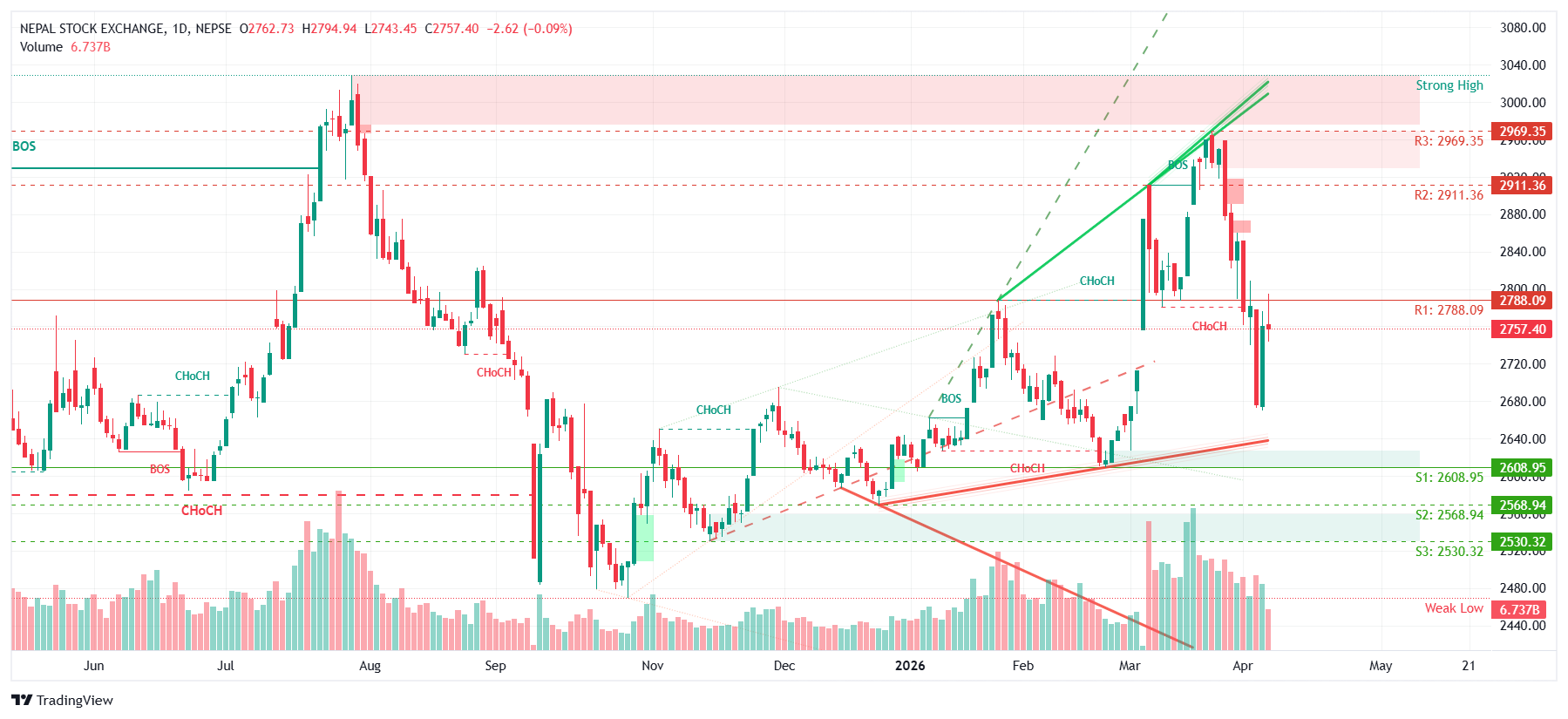
For today's session, two price levels will define everything. On the upside, 2,788 is the immediate and most critical resistance — it is precisely where the market was rejected on Tuesday. A daily close above this level would be the minimum condition for any short-term bullish case to remain valid. On the downside, 2,743 — Tuesday's intraday low — is the first line of defense. If that breaks, the market could slide toward 2,609, then 2,568, and in a worst-case scenario, all the way down to 2,530, according to technical analysts tracking support and resistance zones.
Volume will be the most telling indicator to watch today. If turnover rises alongside a market rally, it would confirm genuine buying interest and suggest that larger participants may be stepping back in. However, if volume expands while the index falls, that would constitute a "strong bearish" signal — one that would demand serious caution from investors of all sizes. Market analysts have noted that large institutional investors remain largely on the sidelines, with retail traders essentially holding the market up on their own. That is rarely a sustainable foundation for a lasting recovery.
In summary, Wednesday's session is expected to open in a cautious and indecisive tone. There are no clear bullish catalysts, yet no signs of outright panic either. The market stands at a genuine inflection point — it will either defend key support levels and signal a potential recovery, or it will break down further and open the door to a deeper correction. How the index closes relative to 2,788 today may well set the tone for the days ahead.
⚠️ Disclaimer: This article is based purely on technical analysis and publicly available market data. Investing in the stock market carries inherent risks. Readers are strongly advised to conduct their own research and consult a qualified financial advisor before making any investment decisions.