#NepalEconomy #FixedCapitalFor
·

By Sandeep Chaudhary

Fixed Capital Formation Decline: What It Means for Investment in Nepal
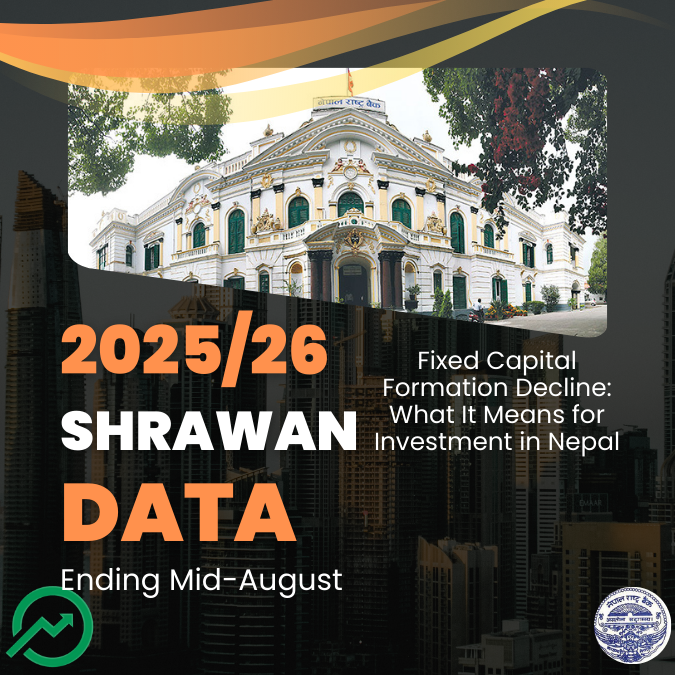
Fixed Capital Formation Decline: What It Means for Investment in Nepal

Nepal’s recent macroeconomic data highlights a worrying trend: the steady decline in Gross Fixed Capital Formation (GFCF), which measures investments in infrastructure, machinery, plants, and other long-term productive assets. In FY 2020/21, GFCF accounted for 29.3% of GDP, but by FY 2024/25, this ratio has fallen sharply to 24.1%. This downward trend indicates that the economy is not building sufficient productive assets, raising concerns about Nepal’s capacity to sustain long-term growth.

The decline reflects multiple structural challenges. First, delays in public infrastructure projects and weak capital expenditure have limited the government’s role in driving investment. Capital expenditure remains stuck at 3.6% of GDP, far below potential, meaning budget allocations for development are either underutilized or inefficiently deployed. Second, private sector investment has slowed due to high uncertainty, policy inconsistencies, and limited credit expansion. While lending rates have eased, with the base rate falling to 6.02% in FY 2024/25, businesses remain cautious, as demand is still recovering and external shocks persist.

The consequences of weak fixed capital formation are significant. Without adequate investment in productive assets, Nepal risks low productivity, limited job creation, and sluggish industrial growth. A heavy reliance on remittances to fuel consumption has kept Gross National Disposable Income rising, but this income is not being effectively transformed into domestic investment. The result is a consumption-driven economy with limited structural transformation. This also explains why, despite high savings—36.2% of GDP in FY 2024/25—Nepal struggles to channel resources into infrastructure, manufacturing, and export-oriented sectors.

For Nepal to sustain higher growth, reversing this decline is critical. Policies must focus on improving project execution capacity, creating a more stable investment climate, and incentivizing private capital formation. Public-private partnerships, reforms in land and energy sectors, and greater policy certainty could help attract both domestic and foreign investors. If Nepal fails to boost fixed capital formation, its growth will remain consumption-heavy, dependent on remittances, and vulnerable to external shocks.
Related Blogs

ABC Securities Investor Pro Meet 2082 Concludes Successfully in Birgunj
Top

3 min read

ABC Securities Investor Pro Meet 2082 Concludes Successfully in Birgunj

ABC Securities Investor Pro Meet 2082 Concludes Successfully in Birgunj The ABC Securities Investor Pro Meet 2082, organized under the financial literacy campaign of ABC Securities, was successfully held in Birgunj with strong participation from investors, market experts, and business leaders. The one-day program included share market training, panel discussions, and interactive sessions aimed at improving investors’ understanding of Nepal’s capital market. According to the organizers, the main objective of the event was to strengthen investors’ knowledge, skills, and confidence so that they can make informed and responsible investment decisions. The program reflected the growing demand for structured and practical market education among Nepalese investors. In recent years, participation in the stock market has increased rapidly, especially among young and first-time investors. However, many of them still lack proper understanding of market risks, technical analysis, and long-term investment planning. By organizing such events, ABC Securities is attempting to bridge this knowledge gap and promote disciplined investment behavior. The ABC Securities Investor Pro Meet 2082, organized under the financial literacy campaign of ABC Securities, was successfully held in Birgunj with strong participation from investors, market experts, and business leaders. The one-day program included share market training, panel discussions, and interactive sessions aimed at improving investors’ understanding of Nepal’s capital market. According to the organizers, the main objective of the event was to strengthen investors’ knowledge, skills, and confidence so that they can make informed and responsible investment decisions. The program reflected the growing demand for structured and practical market education among Nepalese investors. In recent years, participation in the stock market has increased rapidly, especially among young and first-time investors. However, many of them still lack proper understanding of market risks, technical analysis, and long-term investment planning. By organizing such events, ABC Securities is attempting to bridge this knowledge gap and promote disciplined investment behavior.

Dipesh Ghimire

·

23 Feb, 2026