By Dipesh Ghimire
NEPSE in Free Fall: Breakdown Below Key Support Signals Deeper Market Stress

Kathmandu. Nepal’s stock market extended its sharp decline on Wednesday, with the NEPSE index plunging 74.73 points to close at 2,776.36, marking one of the most significant single-day drops in recent sessions. The fall came despite a brief rebound attempt earlier, indicating that selling pressure has firmly taken control of the market. The broader sentiment remains fragile, with investors increasingly driven by fear rather than fundamentals.
The decline was not limited to the benchmark index alone. The Sensitive Index dropped by 11.21 points, while the Float Index and Sensitive Float Index also fell by 5.13 and 4.02 points respectively. More importantly, all 13 sectoral indices ended in the red, reflecting a broad-based sell-off rather than isolated weakness. The “Others” sub-index led the losses with a steep 5.26% decline, followed by development banks, finance, and trading sectors, each falling by over 3%. Banking, hydropower, insurance, hotels, and investment sectors also recorded losses exceeding 2%, confirming a market-wide correction.
Analysts attribute the sharp downturn primarily to the intensifying investigation surrounding Dipak Bhatt, particularly his linkage with Himalayan Reinsurance Limited. The decision to place him on an immigration blacklist has triggered widespread panic among investors. Concerns over the use of large sums of money, possible regulatory violations, and the broader implication of “black money” in the stock market have severely shaken confidence. What initially appeared as a single-case investigation has now evolved into a systemic concern, amplifying uncertainty across the market.
From a behavioral perspective, Wednesday’s session was dominated by panic selling. The market opened weak and continued to slide throughout the day, with no meaningful recovery attempts. This pattern suggests that investors are rushing to exit positions rather than waiting for stabilization. The inability to absorb selling pressure highlights a liquidity imbalance, where supply significantly outweighs demand.
Interestingly, despite the steep fall in prices, total turnover remained relatively strong at Rs 12.10 billion, with over 30 million shares traded across 347 companies. This indicates that market activity has not slowed down; instead, it has shifted toward aggressive selling. High turnover during a falling market is often interpreted as distribution—where large players offload positions to smaller participants—further reinforcing bearish sentiment.
The impact was particularly severe in the insurance segment. Shares of Nepal Reinsurance Company Limited fell by 9.84%, making it the biggest loser of the day. Reports of heavy selling pressure, coupled with limited buying interest, created conditions close to a “sell freeze,” where investors struggled to exit positions. This reflects a deeper issue of eroding trust within key sectors.
At the same time, trading concentration remained high in specific stocks. Himalayan Reinsurance Limited recorded the highest turnover of over Rs 713 million, followed by Api Power and Ngadi Group Power. This suggests that while fear dominates the broader market, certain stocks remain highly active—often due to forced selling, speculative positioning, or liquidity rotation.
Technical indicators further validate the bearish outlook. The index decisively broke below the critical support level around 2,788, a zone that had historically acted as a strong demand area. The breakdown of this level is significant, as it not only invalidates the recent rebound but also transforms the former support into a resistance zone. Additionally, the upward trendline that had been guiding the market’s higher low structure has been breached, signaling a potential shift from an uptrend to a downtrend.
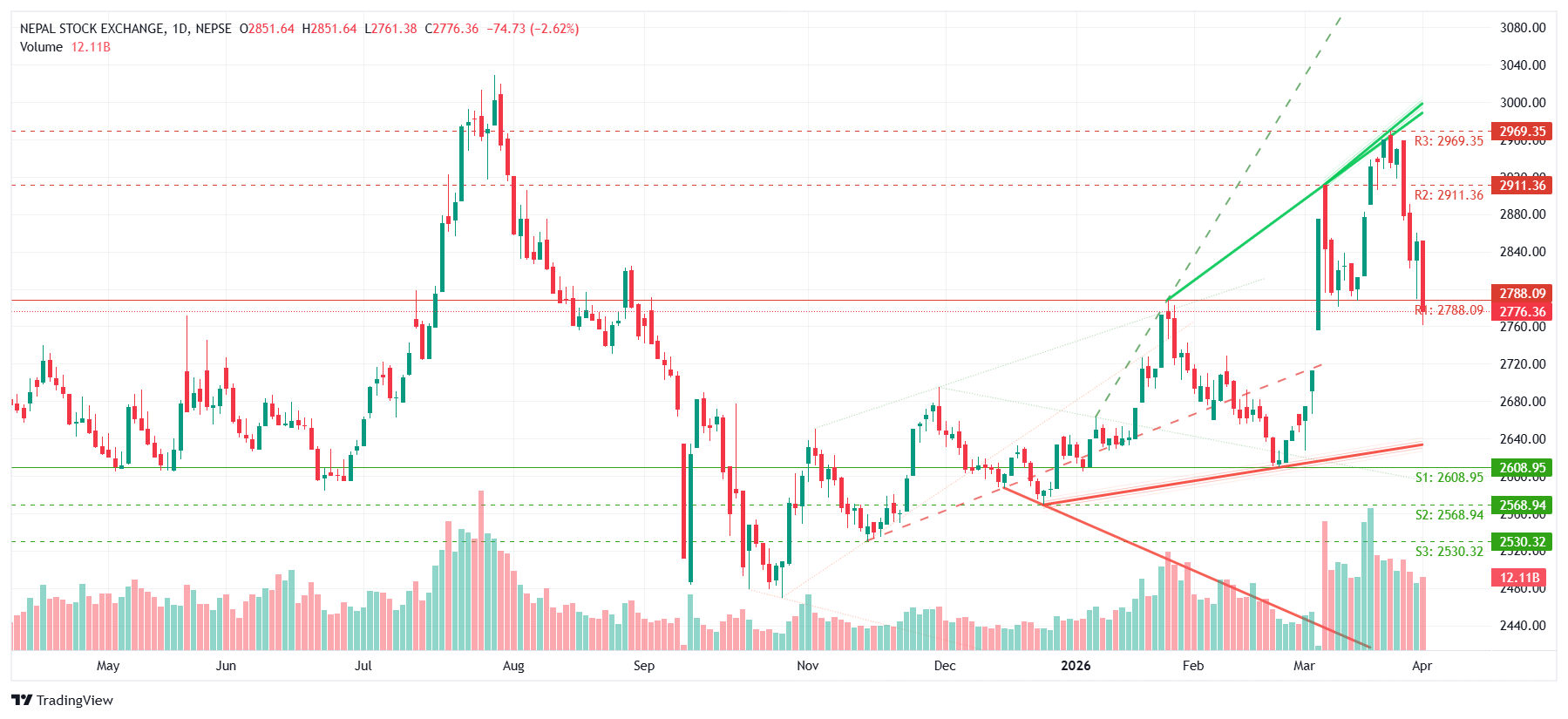
The daily candlestick formed during the session is best described as a “bearish breakdown candle”—characterized by a strong downward move, support violation, and a close near the day’s low. Such a formation typically reflects strong seller dominance and suggests that downward momentum may continue in the near term. The presence of a lower high formation prior to this decline further strengthens the case for a developing trend reversal.
Looking ahead, immediate support levels are now seen around 2,608, followed by 2,568 and 2,530. If selling pressure persists, the index may gradually test these lower zones. On the upside, resistance is expected near 2,911 and 2,969, but given the current momentum, a quick recovery toward these levels appears unlikely.
Beyond technicals, the broader narrative points to a crisis of confidence. The combination of regulatory action, uncertainty around financial practices, and fears of deeper systemic exposure has created a risk-averse environment. Investors, particularly retail participants, appear caught in a difficult position—facing losses on one side and uncertainty on the other.
In conclusion, Wednesday’s market action signals more than just a correction; it reflects a structural shift driven by both technical breakdown and psychological pressure. While regulatory scrutiny may strengthen the market in the long run, the short-term outlook remains volatile. For now, caution prevails, and the market appears to be searching for a new equilibrium amid heightened uncertainty.