Top
Premium IPO Rush Led by Manufacturing Firms Signals Both Opportunity and Risk in Nepal’s Capital Market
Premium IPO Rush Led by Manufacturing Firms Signals Both Opportunity and Risk in Nepal’s Capital Market Nepal’s capital market is witnessing a growing surge of companies seeking to issue Initial Public Offerings (IPOs) at premium prices, with manufacturing and processing firms taking the lead. According to data from the Nepal Securities Board (SEBON), nearly a dozen companies have applied for permission to sell shares above their face value, reflecting rising corporate confidence as well as increasing pressure on regulators to ensure fair valuation.
Dipesh Ghimire
4 min read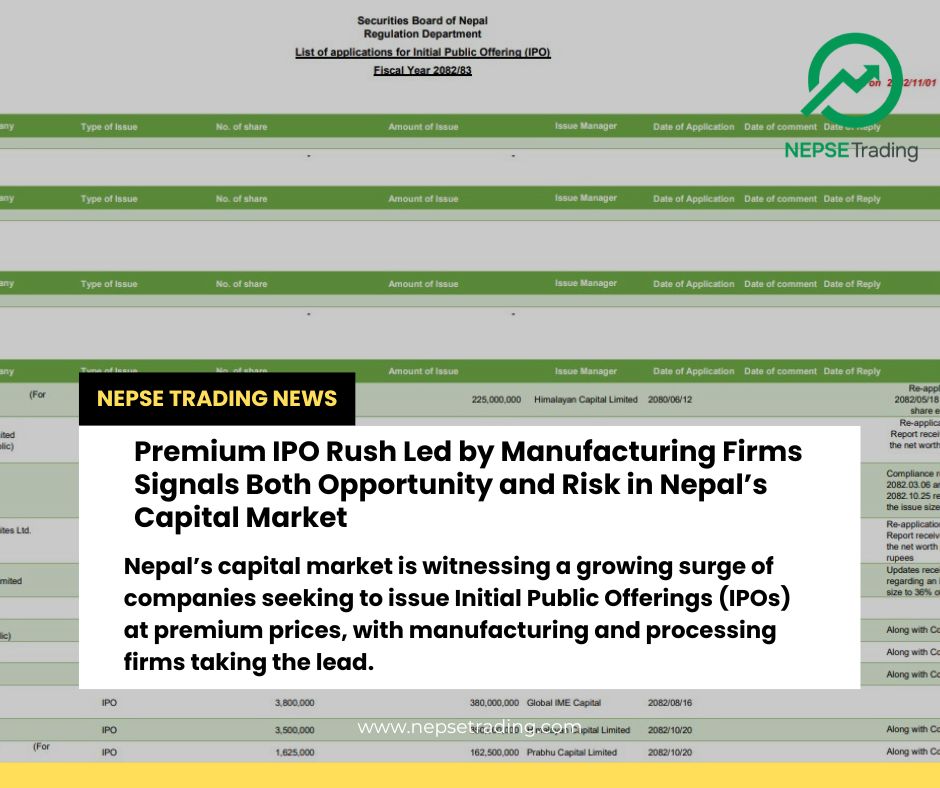
Nepal’s capital market is witnessing a growing surge of companies seeking to issue Initial Public Offerings (IPOs) at premium prices, with manufacturing and processing firms taking the lead. According to data from the Nepal Securities Board (SEBON), nearly a dozen companies have applied for permission to sell shares above their face value, reflecting rising corporate confidence as well as increasing pressure on regulators to ensure fair valuation.
Among these applicants, production-based companies have emerged as the most dominant group. Seven of the companies seeking premium pricing belong to the manufacturing sector, while two represent hydropower, two fall under service and commercial activities, and one operates in the investment sector. This pattern indicates that capital-intensive industries are increasingly turning to the public market to finance expansion and repay existing obligations.
Several major industrial firms have already submitted proposals at significantly high prices. Jagdamba Steels, Shaurya Cement, Maruti Cements, Riddhi Siddhi Cement, Ambe Steels, Hulas Infra, and Hulas Iron Industries are among the prominent names seeking approval. Most of these firms are involved in steel, cement, and infrastructure-related production, sectors that have benefited from construction growth and urban development in recent years.
However, analysts caution that high demand for industrial products does not automatically justify premium valuation. While some of these companies have improved their revenue base, others remain burdened with debt and fluctuating profitability. Without strong and consistent financial performance, premium pricing may expose small investors to long-term risks.
The trend is not limited to manufacturing alone. Hydropower companies such as Century Energy and Numbur Himalaya Hydropower have also applied for premium IPOs. Despite strong public interest in energy projects, many hydropower firms continue to face delays related to power purchase agreements, technical readiness, and commercial operation dates, making their earnings outlook uncertain.
Similarly, companies from other sectors are also entering the premium IPO race. Kailash Helicopter Services and Chhaya Devi Complex have proposed offerings at comparatively high prices, while Shivam Holdings from the investment sector has also sought approval. This expanding participation suggests that premium IPO pricing is gradually becoming a common practice across industries.
In recent years, Nepal’s stock market has seen a rapid rise in public offerings as companies look for alternative sources of capital. Compared to the past, the number of firms demanding premium rates has increased sharply. Market observers believe this reflects both improved access to capital markets and rising optimism among promoters.
At the same time, concerns are growing that some promoters may be using IPOs mainly as exit tools rather than as platforms for long-term growth. By selling shares at high valuations, early investors and owners can secure quick returns, leaving public shareholders exposed to uncertain future performance.
According to SEBON records, a total of 92 companies are currently waiting in the IPO pipeline. These firms plan to issue more than 416 million shares worth around NPR 59.63 billion. While this indicates strong supply in the primary market, slow approval procedures have delayed listings, prolonging investor anticipation.
Sector-wise, hydropower companies dominate the pipeline with 32 applicants, followed by 25 firms from the manufacturing and processing sector. Together, these two sectors account for the majority of planned fundraising. Experts note that both sectors require heavy capital investment and long payback periods, increasing the importance of careful project evaluation.
The hotel and tourism sector has also shown renewed interest, with 12 companies preparing to issue shares. As tourism gradually recovers, these IPOs are seen as long-term opportunities. However, profitability in this sector remains sensitive to political stability, global travel trends, and economic conditions.
Investment companies, micro-insurance providers, and other service firms are also awaiting approval. While regulatory reforms have improved governance in some areas, financial transparency and risk management remain critical challenges, particularly for smaller institutions.
Market analysts warn that if many IPOs are launched simultaneously, liquidity could be diverted from the secondary market. With trading volumes currently modest and investor sentiment unstable, excessive supply may weaken overall market performance.
Although declining interest rates have made equity investment more attractive, experts advise investors to avoid blindly subscribing to every new offering. Project-based firms, especially in hydropower and manufacturing, require detailed assessment of costs, timelines, and revenue stability before investment decisions are made.
Regulatory authorities are therefore expected to play a stronger role in screening applications. By prioritizing financially sound and well-governed companies, SEBON can help restore confidence and prevent speculative pricing from damaging the market.
Ultimately, the expanding premium IPO pipeline reflects both progress and vulnerability in Nepal’s capital market. On one hand, it shows growing corporate participation and access to public funding. On the other, it highlights the risk of overvaluation and short-term profit motives.
In the coming months, how regulators manage approvals and how investors respond will determine whether this IPO wave strengthens market stability or adds to existing volatility. For now, cautious optimism remains the dominant sentiment among market participants.
Advertisement
Written by
Dipesh Ghimire