#NepalEconomy #WageGrowth #Sal
·

By Sandeep Chaudhary

Wage and Salary Index Growth: Are Nepali Workers Falling Behind?
Wage and Salary Index Growth: Are Nepali Workers Falling Behind?

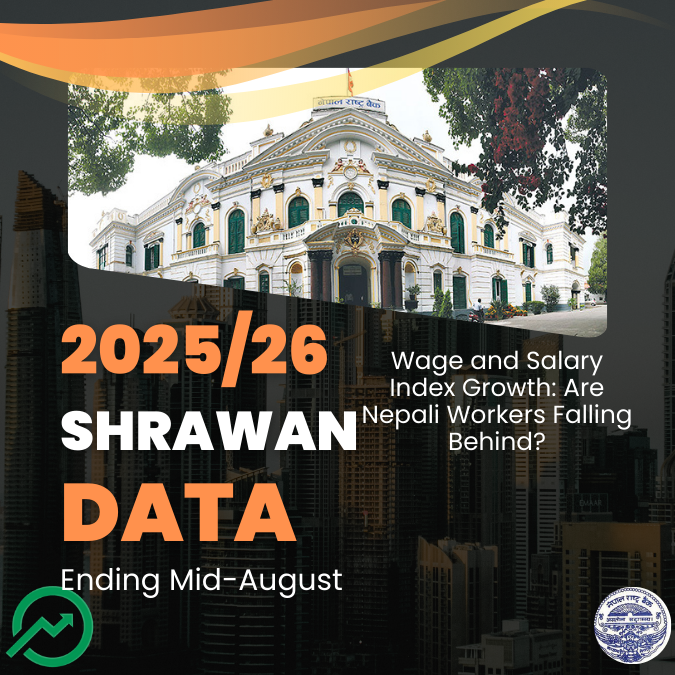
The Salary and Wage Rate Index in Nepal offers critical insights into how workers’ earnings are evolving relative to inflation and overall economic growth. Over the past five years, the index has shown significant fluctuations. In FY 2020/21, growth was just 2.76%, reflecting the lingering slowdown from the pandemic. It jumped sharply to 9.09% in FY 2021/22 and 8.71% in FY 2022/23, driven by post-COVID labor market adjustments, increased demand in certain sectors, and rising inflationary pressures. However, this momentum has not been sustained: wage growth slowed to 3.56% in FY 2023/24 and further to just 2.63% in FY 2024/25, signaling stagnation in workers’ income growth.

When these wage trends are compared with inflation, the picture becomes more concerning. During periods of high inflation—such as FY 2021/22 (8.08%) and FY 2022/23 (7.44%)—wage growth barely kept pace, meaning workers’ real incomes did not increase significantly. In contrast, as inflation cooled to 2.20% in FY 2024/25, wage growth also weakened to 2.63%, suggesting that employees are not fully benefiting from price stability. Essentially, while households faced higher living costs during inflationary peaks, they are now seeing limited income growth even as prices stabilize.

This mismatch raises the question: are Nepali workers falling behind? The answer leans toward yes. Although nominal wages have increased in recent years, they have not consistently outpaced inflation, which means real purchasing power remains stagnant. The slowdown in wage index growth also points to structural weaknesses in the labor market—such as underemployment, dominance of low-productivity jobs, and limited industrial expansion—that prevent meaningful income gains for workers.

The implications are wide-ranging. Stagnant real wages constrain domestic demand, limit household savings, and reinforce dependence on remittances. For Nepal to ensure that workers are not left behind, policies must focus on creating higher-productivity jobs, strengthening labor rights, and linking wage growth more closely to economic performance and productivity gains. Without such reforms, wage stagnation risks widening inequality and undermining the benefits of macroeconomic stability.

Related Blogs

ABC Securities Investor Pro Meet 2082 Concludes Successfully in Birgunj
Top

3 min read

ABC Securities Investor Pro Meet 2082 Concludes Successfully in Birgunj

ABC Securities Investor Pro Meet 2082 Concludes Successfully in Birgunj The ABC Securities Investor Pro Meet 2082, organized under the financial literacy campaign of ABC Securities, was successfully held in Birgunj with strong participation from investors, market experts, and business leaders. The one-day program included share market training, panel discussions, and interactive sessions aimed at improving investors’ understanding of Nepal’s capital market. According to the organizers, the main objective of the event was to strengthen investors’ knowledge, skills, and confidence so that they can make informed and responsible investment decisions. The program reflected the growing demand for structured and practical market education among Nepalese investors. In recent years, participation in the stock market has increased rapidly, especially among young and first-time investors. However, many of them still lack proper understanding of market risks, technical analysis, and long-term investment planning. By organizing such events, ABC Securities is attempting to bridge this knowledge gap and promote disciplined investment behavior. The ABC Securities Investor Pro Meet 2082, organized under the financial literacy campaign of ABC Securities, was successfully held in Birgunj with strong participation from investors, market experts, and business leaders. The one-day program included share market training, panel discussions, and interactive sessions aimed at improving investors’ understanding of Nepal’s capital market. According to the organizers, the main objective of the event was to strengthen investors’ knowledge, skills, and confidence so that they can make informed and responsible investment decisions. The program reflected the growing demand for structured and practical market education among Nepalese investors. In recent years, participation in the stock market has increased rapidly, especially among young and first-time investors. However, many of them still lack proper understanding of market risks, technical analysis, and long-term investment planning. By organizing such events, ABC Securities is attempting to bridge this knowledge gap and promote disciplined investment behavior.

Dipesh Ghimire

·

23 Feb, 2026